Grammarly, the popular editing service, has integrated an “Expert Review” feature that offers advice attributed to countless well-known personalities in media and publishing. No permission has been granted by these experts for such use. In a statement to The Verge, a representative from the company said, “The Expert Review agent doesn’t claim endorsement or direct participation from those experts; it provides suggestions inspired by works of experts and points users toward influential voices whose scholarship they can then explore more deeply.” Read Stevie Bonifield at The Verge.
Casey Newton is one of the writers who didn’t offer permission for his name or likeness to be turned into a Grammarly feature. He has opted out and shares an email address that anyone can use to opt out. I did so immediately. Learn more.
While I’m not a lawyer, this looks like a potential violation of right of publicity, a law that varies by state. Because this problem affected me in 2023—and I anticipated it would only get worse—I trademarked my name in 2024. That means if Grammarly uses my name, I could have a case under the Lanham Act, the primary federal trademark law in the US. Learn more about the process of obtaining a trademark.
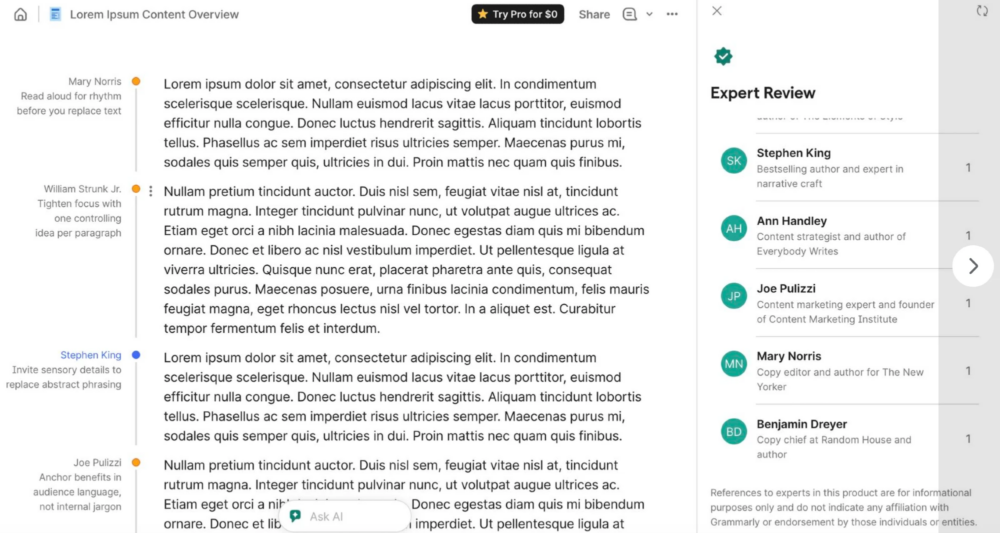
Update
Within hours of this article’s publcation, Grammarly pulled down the feature and was also sued. Read the New York Times op-ed (gift link) by the person suing.

Jane Friedman has spent her entire career working in the publishing industry, with a focus on business reporting and author education. Established in 2015, her newsletter The Bottom Line provides nuanced market intelligence to thousands of authors and industry professionals; in 2023, she was named Publishing Commentator of the Year by Digital Book World.
Jane’s expertise regularly features in major media outlets such as The New York Times, The Atlantic, NPR, The Today Show, Wired, The Guardian, Fox News, and BBC. Her book, The Business of Being a Writer, Second Edition (The University of Chicago Press), is used as a classroom text by many writing and publishing degree programs. She reaches thousands through speaking engagements and workshops at diverse venues worldwide, including NYU’s Advanced Publishing Institute, Frankfurt Book Fair, and numerous MFA programs.