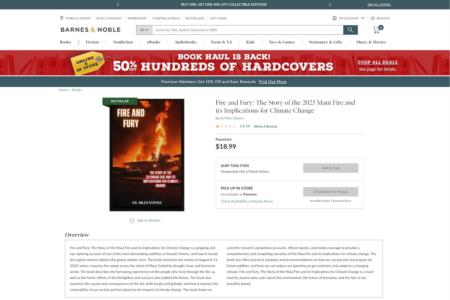
One thing is certain: More than a few authors are using AI tools to assist in the writing and editing process, whether their publishers know about it or not. Right now, publishers’ policies, if they exist at all, ask authors to disclose how AI was used to produce the final work. If authors do disclose, at what point is an ethical or legal line crossed in their use of AI? And how can publishers know if the author is being honest?
These questions and more were discussed earlier this month during a Book Industry Study Group panel moderated by Thad McIlroy, a digital publishing analyst and author based in San Francisco.
While excellent AI detection tools exist, they are not 100 percent accurate. They work better on longer samples or when a humanizer has not been used. A humanizer is a class of products that make AI-generated texts sound more human—and there are also actual humans who will do this for a price. This makes it harder to detect the use of AI.
One of the panelists, Max Spero, is co-founder of Pangram Labs, a company that creates AI detection tools. Spero says the biggest use of their tool so far is prevention of fraudulent customer reviews. “Review platforms actually have a huge problem right now because previously they were using contextual signals to figure out what kind of content is spammy,” he said. But now there’s a deluge of AI-generated reviews getting through. Social media sites like Quora have also been flooded with AI-generated content, where people want to look like experts even when they’re not. They’ll answer questions by asking ChatGPT and pasting in the answer.
Every time AI detection tools improve, the fraudsters also improve. Spero said, “It’s absolutely a cat-and-mouse game, the same way spam has been cat and mouse for two plus decades.” Recently Pangram retrained their model on GPT-4o, Claude 3, and Llama 3, and they raised accuracy rates to 99.84 percent—but there’s still a lot of work to be done. Panelist José Antonio Bowen, an author and academic, pointed out that research studies on AI detector accuracy, almost as soon as they’re released, are entirely out of date because it’s impossible to keep up with the pace of change.
An underlying complication: Much of human writing is already hybrid. Bowen said, “We already use things like dictionaries and a thesaurus and spell checker. Those are somebody else’s intellectual work.” Everyone today finds these tools ethical, along with more intensive editing and proofreading tools like Grammarly. But Grammarly now has AI built into it and can rewrite your work. “What we consider to be original and creative is probably going to undergo some stress,” he said.
During Q&A, someone asked about book awards that don’t allow for AI-generated writing. How does anyone detect AI use? In short, no one can know for certain. Bowen said, “There could be lots of ways that AI has contributed to that book—written sentences, offered alternatives for paragraphs or voice that might be detectable but might also be ethical. … If you say you can’t have any AI writing in an award-winning book, what does that mean? Does that mean no sentences? No word suggestions?” That kind of AI use will be hard to detect, he said, but does it matter? Is that wrong?
The larger point: AI can play a role at all stages of the writing and publishing process that many professionals would find acceptable and ethical. “Writing is not just writing. Writing is brainstorming, it’s the thesis, it’s the outline, it’s the drafting, it’s the editing, it’s thinking about audience, it’s checking references, it’s all of those things,” Bowen said. “AI should make writing and editing better across the board.” While it may be unethical for someone to use AI to generate 5,000 spammy reviews, in other cases, people prefer AI content, like when it’s used to improve summaries of scientific articles. “You could detect those, but why bother? They’re better,” he said.
It’s important to differentiate between two types of AI use in the writing and publishing process, said Gregory M. Britton, editorial director at Johns Hopkins University Press. One is content creation, which publishers have ethical and legal concerns about, and the other is the content management, or the editorial tools, which JHU encourages. “I think it would be foolish for an author to submit a manuscript without running spell check on it before they turn it in,” and he sees AI editing tools as analogous. Bowen (whose latest book on AI is published by JHU) said he used AI to find all the places where he may have been repetitive in the manuscript, and he also used AI successfully to help him with fact-checking and citations. He disclosed all of this use to his editors. Some may be surprised that AI can find factual errors in a manuscript, given the problematic results it can generate, but much depends on the tool, the user, and the prompt. Which brings us to the next important point.
Authors are responsible for the quality and correctness of their work, whether they use AI or not. Even if the use of AI in content creation blurs the lines of intellectual property and originality, authors remain accountable for the quality of their work. That means you can’t blame the AI for getting something wrong; you remain responsible for vetting what the AI does.
Bottom line: Even those who question the ethicality of generative AI believe that writers and students today should (or must) learn to use it. “What faculty and teachers call cheating, business calls progress,” Bowen said. “If you say you can’t use a tool or refuse to use it, your colleagues who use the tool will complete their work faster and better.” In other words, AI is raising the average. However, Bowen said, “AI is better than 80 percent of humans at a lot of things, but it’s not better than the experts. … The best writers, the best experts are better than AI.”

Jane Friedman has spent her entire career working in the publishing industry, with a focus on business reporting and author education. Established in 2015, her newsletter The Bottom Line provides nuanced market intelligence to thousands of authors and industry professionals; in 2023, she was named Publishing Commentator of the Year by Digital Book World.
Jane’s expertise regularly features in major media outlets such as The New York Times, The Atlantic, NPR, The Today Show, Wired, The Guardian, Fox News, and BBC. Her book, The Business of Being a Writer, Second Edition (The University of Chicago Press), is used as a classroom text by many writing and publishing degree programs. She reaches thousands through speaking engagements and workshops at diverse venues worldwide, including NYU’s Advanced Publishing Institute, Frankfurt Book Fair, and numerous MFA programs.