

Today’s post is by Dan Parsons (@dkparsonswriter), author of Networking for Authors.
Networking is a key skill that can benefit any author’s career, now more than ever as writers are increasingly able to build their own publishing empires without a traditional deal. Done well, it can reveal opportunities, spark friendships and stabilize your business to weather industry-wide shifts.
However, as much as many writers have a grasp on the benefits of networking, they often don’t understand the mindset required to optimize their experiences. In this blog post, we will address a number of mindset shifts you can make to harness the power of networking to its full extent.
1. You Are the Boss
Effective networkers communicate with strength, mutual respect and an eye for opportunities. This mentality is commonplace among entrepreneurs but it’s not always the case for authors because, historically, we haven’t communicated from a position of strength. As close as just over a decade ago, authors couldn’t approach publishers as equals, where both parties could walk away from a contract and choose an alternative path.
Until now.
As a modern author, you can go it alone and build your own team. That’s not to say publishers are now irrelevant. Some authors don’t want to run a fully independent operation so, in those cases, a traditional contract is the perfect deal. Knowing you have options, though, will make you a better negotiator because you can afford to say no and walk away. The shift has brought equality to the book industry and highlighted that authors’ work is crucial for generating revenue. So, if you’re a writer, start thinking like one.
If you’re still struggling to act like a power player then a trick I find useful is to imagine myself as an employer interviewing a potential new starter, rather than a newbie hoping for a job. Do this and, rather than heading into conversations nervous and desperate, you’ll adopt a more relaxed manner and have genuine conversations in which you can assess objectively whether working with a new contact will really align with your goals.
2. Honesty is Your Path to Opportunities
Confidence can help you get noticed in social gatherings but faking it ‘til you make it shouldn’t be applied to every networking decision. Sure, faking confidence can help you overcome crippling insecurities to visit a conference in the first place. However, lying about how much success you’ve achieved to catch the attention of powerful contacts will only hurt your reputation. With the internet omnipresent, it’s easy to spot a fraud, generally by their Amazon sales ranks and number of reviews.
Honesty is a better strategy because it enables you to form more powerful relationships. Many authors don’t pull in thousands of dollars a month so letting your contemporaries know you’re on a similar level will not only establish camaraderie but will enable you to give and receive better advice. Knowing you’re only making pocket change, your peers will give you manageable strategies to build that income rather that suggesting you drop a small fortune on ads that drive traffic to books that aren’t already converting readers.
3. Everyone’s Time is Valuable
Rambling is not a good quality in writing or networking. To avoid it, keep in mind two things: 1) everyone’s time is valuable, including your own, and 2) your message must be clear. That’s because, if people are attending a networking event, they want something out of it: knowledgeable friends, co-writers, marketing intel—whatever. As a result, they need to meet as many acquaintances as possible to find the right fit. This isn’t selfish. It’s the whole point you’re both there, which is why you don’t want to spend all day talking to one person.
An elevator pitch can help speed up the process. If you don’t know, it’s a short sales hook that summarizes a product or service (in this case you and your books), which allows you to network more efficiently.
For example, a sci-fi author, might say:
“Hi, I’m Rosie—a sci-fi writer.”
If probed further, she would add:
“I’ve written a young adult sci-fi story about a teenage girl. When her cousin is abducted by a dictator and forced to be a gladiator, the heroine works to save him alongside a boy who has loved her since childhood.”
Finally, she might release more details:
“I’ve sold 20,000 books and have an organic mailing list of about 4,000 members.”
Specificity is key. You see, saying Rosie is a sci-fi author doesn’t reveal her books’ nuances—the romance and dystopian elements. Without them, another sci-fi writer might agree to run a newsletter swap only to discover they’re promoting a romance-heavy young adult story to their military-loving robot fans. Of course, knowing the details in advance will make the encounter less awkward and can help both writers form a friendship not tarnished by one party cancelling their deal.
Also, notice how quickly the example dispenses key figures? It might seem robotic but that’s exactly the information many new contacts want. Are you an author? What do you write? How successful are you? It’s important not to lead with numbers because it can look like bragging. Normally, if nobody asks, I wouldn’t share them but, if someone is clearly fishing to see if we’re on the same level, stating raw numbers is the fastest way to clarify.
The average person will decide if they want to work with you pretty soon after they learn your genre and success level anyway so you might as well fast-track the process. Those who like what they hear will stick around and those whose work isn’t applicable will be able to move on without having wasted time. Everyone wins.
4. You Don’t Want to Sell Your Book
Trade networking events take on many forms. Sometimes they happen in formal convention halls, everyone on their best behavior; other times they are in bars or restaurants with a more relaxed atmosphere. In both scenarios, successful writers don’t often sell their wares to other authors. If anything, a pitch will be on a B2B basis where books are licensed or sold to resellers in bulk, and meetings are organized weeks in advance. Even then, no contracts are signed. They come later, after everyone has had time to consider their decision.
In most cases, effective business moves are made without selling… a physical product. Selling does happen, but it’s not your book you’re selling: it’s you. After all, likability is rocket fuel for long-term success. For many full-time authors who work from home, they don’t have an office Christmas party or work nights out. Therefore, these events are their equivalent: somewhere where they can relax and talk shop over a coffee or cocktail. It’s a time to catch up with friends and make new ones.
Just some of the opportunities you can get by adopting this mentality include co-writing projects, copywriting work, cross promotions with other authors and podcast appearances. All will boost your status and book sales without you hand-selling at events. Sure, in some cases, deals can take several encounters to blossom, but they do happen. You might want to keep that in mind the next time you think about pressing a copy of your book into someone’s hand. Don’t think about selling what you’ve written; consider selling your personality because that will make people want to help you succeed.
5. You Can Provide Value
One common insecurity writers face when they first start networking is that they believe they have nothing to contribute to conversations. And while you might not always have a lot of publishing knowledge or experience, you will have other areas of expertise. Writing is a varied job and authors like to research random topics for whatever story or non-fiction book they’re writing at the time. This means, in many cases, they will happily trade publishing knowledge or make introductions on your behalf in exchange for you answering questions about their current obsession.
Do you have kids? That might seem ordinary to you but some writers don’t and would love access to your experiences of childbirth or raising a toddler. Do you work in crime? There are a lot of thriller authors who revel in obscure details of police procedure and criminal psychology. What about sports nutrition? Medicine? Reading tarot cards? If doesn’t matter what you know. What matters most is that you know things that others don’t and can easily build a conversation around that topic to showcase your value.
Having a healthy, positive mindset is the best foundation you can give yourself when entering the networking arena. If you aim for freedom, believe in your own value, remain honest and respect everyone’s time you will see long-term results and minimal stress. Of course, you won’t be immune to failures—everyone has bad days—but a good mindset will give you the tools you need to brush yourself off and forge on, undeterred, just like the authors you use as inspiration have done before you.
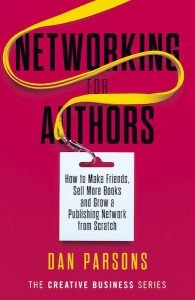
Note from Jane: if you enjoyed this post, check out Dan’s new book Networking for Authors.

Dan Parsons is the bestselling author of eight books. His first Creative Business guide, The #ArtOfTwitter, was an Amazon Business bestseller and one of Book Authority’s Top 100 Digital Marketing Books of All Time. Its follow-up, Networking for Authors, has been featured on the popular blog The Self Publishing Formula and leading podcasts like The Indie Author Mindset where it was endorsed by USA Today bestseller Adam Croft.
Dan’s fantasy and horror novels (published under Daniel Parsons) have topped multiple fiction bestseller charts in four countries and have been used in the marketing campaign of a major Hollywood movie.
Besides writing, Dan has worked for three traditional publishing companies and two bookstores in South Wales, UK. For a free author networking ebook and entrepreneurial ninja tips, join Dan’s network at: DanielParsonsBooks.com/Networking.