
During a fiction writing class I hosted last year, a novelist said there’s been recent pushback from readers who say the real word is too stressful and they don’t want conflict in their reads. Instead, they just want vibes. That, in a nutshell, describes cozy fantasy.
Most readers today have lived through a global pandemic, personally dealt with growing political polarization, witnessed brutal wars, and worried about natural disasters. Quite logically, escapist fiction sales have been growing in response. In her assessment of 2025 trends, agent Anna Sproul Latimer wrote (sub required), “Readers have less energy than ever. They feel less safe than ever. They feel less capable than ever. They don’t feel that they’re one TED Talk or evo-psych lecture from their best life, the way they did in the 2000s; they also don’t feel like they’re one great business idea from kickass #GirlBoss domination, the way they did in the 2010s. For the most part, they feel tired and bitter—in a mood to refuse, to stay home, to Brian Wilson it in bed for a bit.”
K-lytics has recently released its first-ever report on the cozy fantasy genre by Alex Newton, and it’s outstanding in its depth and quality. Newton says it’s the most complex research he’s had to conduct in years because it cuts across every genre that sells today. So far, cozy fantasy does not have a dedicated category on Amazon or bestseller lists, which makes it more challenging to analyze. If you were to search for cozy fantasy at Amazon, you’d get around 7,000 results, but Newton says roughly 700 are in fact cozy fantasy, even using a broad definition of the genre.
What is cozy fantasy? This is where Newton’s report goes deep, analyzing the many definitions that now exist for this genre. Though sharing some qualities with most fantasy subgenres, cozy fantasy distinguishes itself through low-stakes adventures, personal growth, and a strong sense of community. Settings are often charming little villages—a place to escape from the grim realities of everyday life, inviting readers to immerse themselves in a world filled with magic and wonder, with heartwarming connections with other people or creatures.
Newton says that it’s best to approach cozy fantasy from the vibe or emotion these books invoke in the reader. It’s rarely about narrative conventions. He says he’s reminded of the Central Perk Café in the popular TV sit-com Friends: Transform that coffee shop into a magical tavern, and “the drama is about who gets the enchanted couch,” he says. He quotes Sarah Beth Durst, author of The Spellshop, who says, “Cozy fantasy is like Lord of the Rings, but you never leave the Shire.” You feel like you’re sitting in Bilbo Baggins’s home, a symbol of comfort, safety, and the joy of everyday pleasures.
According to Newton, there are 12 defining elements of cozy fantasy.
- Heartwarming story with an optimistic resolution (Legends & Lattes by Travis Baldree, Tor)
- Strong themes of healing and personal growth (The Very Secret Society of Irregular Witches by Sangu Mandanna, Berkley)
- Low stakes and minor challenges (Can’t Spell Treason without Tea by Rebecca Thorne, Tor)
- Slice-of-life charm and simple life tradition (The Tea Dragon Society by Katie O’Neill, Oni Press)
- Inviting setting and soft world-building (A Psalm for the Wild-Built by Becky Chambers, Tor)
- Sensory immersion (A Wizard’s Guide to Defensive Baking by T. Kingfisher)
- Deliberate pacing (Tress of the Emerald Sea by Brandon Sanderson)
- Character-driven story (The House in the Cerulean Sea by TJ Klune, Tor)
- Non-traditional protagonist and fantasy creatures (Dealing with Dragons by Patricia C. Wrede, HarperCollins)
- Sense of community and belonging (Nettle & Bone by T. Kingfisher, Tor)
- Humor and lightheartedness (Howl’s Moving Castle by Diana Wynne Jones, HarperCollins)
- Gentle everyday magic, whimsy, and wonder (The House Witch by Delemhach, Podium)
Newton believes cozy fantasy may have benefited from the longer-term ASMR trend. ASMR stands for “autonomous sensory meridian response,” sometimes described as “the tingles,” which can help people relax. (You can find many ASMR videos on YouTube. Learn more.) Cozy fantasy is like a literary ASMR experience, Newton says, tied to the rising demand for comfort-focused media.
Placing cozy fantasy in relation to other genres can be complicated, especially as other genres try to claim their stake in this area. But Newton does his best and discusses the overlap at length, as summarized by this chart. (He also draws connections across the history of literature—including ancient Greek and Roman poets, pastoral literature, the domestic novel, and fairy tale revivals.)
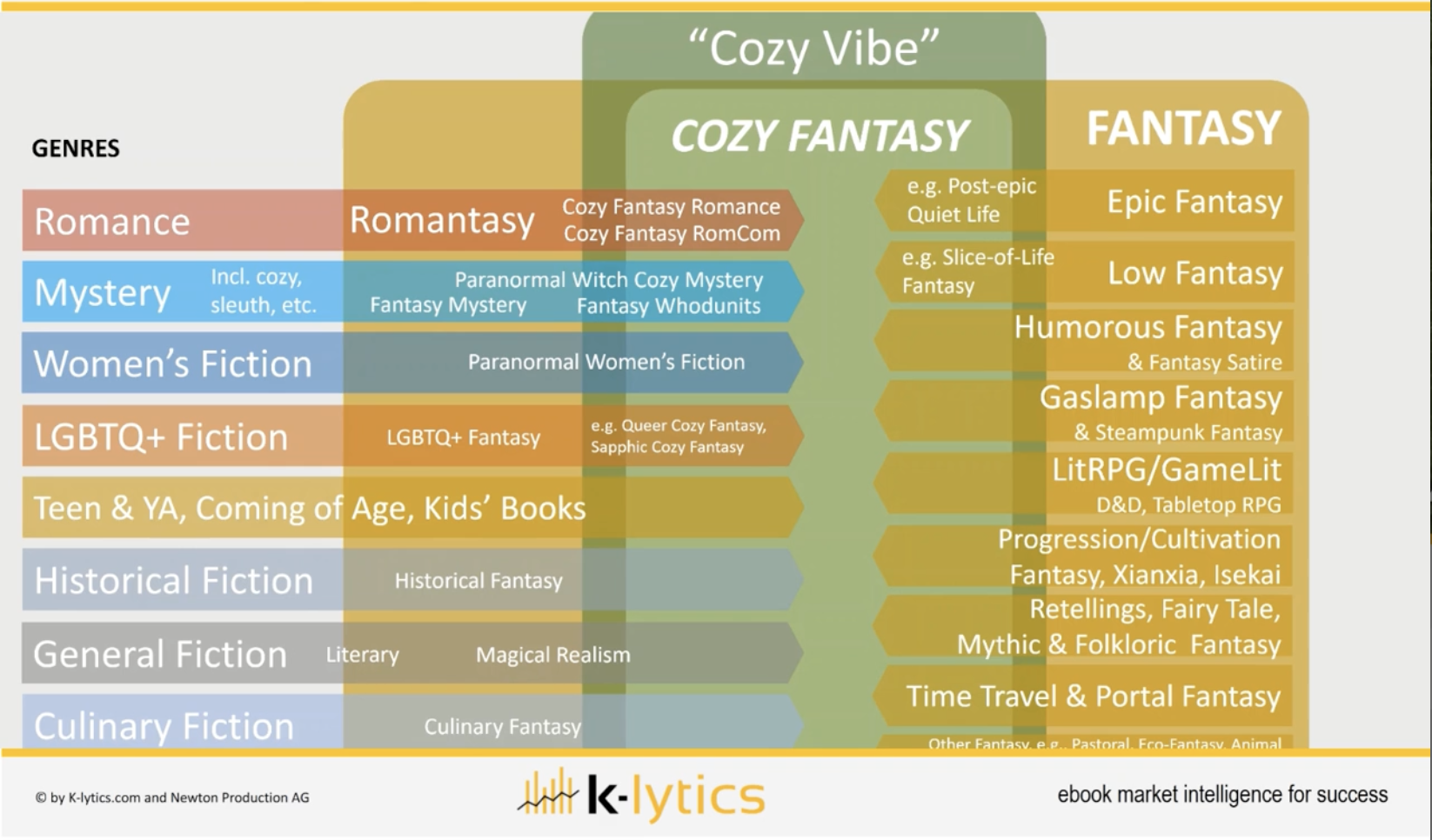
Bottom line: The rise of cozy fantasy offers important signals for all writers, in all genres, as readers seek out comfort reads. Fiction writers who are baffled by readers looking for conflict-free stories can rest assured that readers still want engaging stories, but they are increasingly drawn to those that offer a sense of warmth, hope, and emotional connection—and a reprieve from the stress of daily life. Newton’s report on the cozy fantasy genre offers far more detailed insights on what types of stories are succeeding right now.

Jane Friedman has spent her entire career working in the publishing industry, with a focus on business reporting and author education. Established in 2015, her newsletter The Bottom Line provides nuanced market intelligence to thousands of authors and industry professionals; in 2023, she was named Publishing Commentator of the Year by Digital Book World.
Jane’s expertise regularly features in major media outlets such as The New York Times, The Atlantic, NPR, The Today Show, Wired, The Guardian, Fox News, and BBC. Her book, The Business of Being a Writer, Second Edition (The University of Chicago Press), is used as a classroom text by many writing and publishing degree programs. She reaches thousands through speaking engagements and workshops at diverse venues worldwide, including NYU’s Advanced Publishing Institute, Frankfurt Book Fair, and numerous MFA programs.
