Changes in sales and reading practices continue as some shutdown orders are lifted
As BookExpo and BookCon move online, all eyes turn toward the biggest industry show of the year, Frankfurt Book Fair, scheduled for mid-October. The event typically attracts around 175,000 trade visitors and 128,000 members of the public. It can’t possibly run without modification, that’s certain. Fair director Juergen Boos says it will be a “completely different” experience and several fair events will be made available virtually. More info will come in early June.
A round of layoffs hit Macmillan last month; Publishers Lunch estimates that about 25 to 35 jobs were eliminated across Tor, St. Martin’s, Holt, and FSG.
Book sales update
According to NPD BookScan, print retail sales remain resilient—and even appear to be returning to normal, with a resurgence in adult fiction and nonfiction sales. Year on year, BookScan reports that print unit sales have declined only 2.2 percent overall, a remarkable performance given the retail lockdown. With bookstores closed and libraries shifting to digital purchasing, publishers are likely seeing far more sales through mass-market retailers, with juvenile books especially selling at places like Walmart, Target, drugstores, grocery stores, and other big-box stores that remain open. But certainly Amazon and other online retailers have also played a major role in keeping the print numbers up. (The market share of independent bookstores is quite small—in the single digits—whereas Amazon is presumed to account for half of all US print sales.)
Keep in mind that BookScan tracks only print retail sales, not libraries. Jim Milliot at Publishers Weekly writes, “With many libraries closed, trade publishers who do significant business through that channel are likely seeing softer sales.”
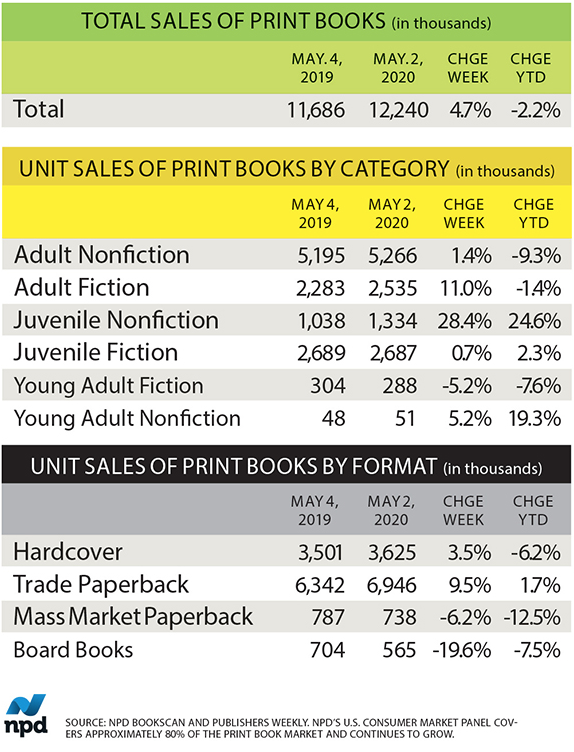
- Week ending April 26: Print unit sales are up by 10 percent versus the prior week, but down by nearly 4 percent versus 2019. Adult sales start to come back, with gains in general fiction, romance, and suspense thrillers; nonfiction sees a sales increase in biography/memoir, health and fitness, reference, religion, and self-help. Year to date, units are down 3.2 percent compared to a year ago.
- Week ending May 2: NPD BookScan reports that total print units are up 11 percent versus the previous week—and compare favorably to the same week a year ago, up by nearly 5 percent. In good news for novelists, growth came from adult print sales, with a gain of 11 percent in adult fiction, driven by John Grisham’s Camino Winds. Graphic novel sales jumped by 43 percent.
- Storytel announces revenue growth of 33.5 percent in its first quarter. The ebook and digital audiobook subscription service—primarily serving Europe—is, as expected, performing well. Their report notes the children’s category is its third most popular, becoming second most popular at bedtime. (Crime/thriller is number one.)
- In China, during the first quarter, the overall book retail market declined by almost 16 percent versus the prior year. The picture looks the most grim when focusing on bookstores alone, not factoring in online retail. According to Porter Anderson at Publishing Perspectives, brick-and-mortar bookstores experienced about a 55 percent drop in sales during the first quarter versus 2019.
- Ireland’s print sales have seen a 29 percent decline during lockdown versus last year. According to Nielsen BookScan, adult nonfiction has been hardest hit, down 35 percent year on year. However, nonfiction coloring, activity, and crafts books have soared, as they have in other countries. Adult fiction declined 28 percent; children’s fell by 25 percent.
On the self-publishing side of the market, where ebooks dominate, PublishDrive has shared how sales have shifted due to coronavirus. Their data encompasses 10,000 authors selling in 400 stores and libraries across the globe. Overall, unit sales have increased 20 percent in March 2020 versus February 2020. Most of that growth is coming from regional stores, which saw a 126 percent increase; these are outlets that cover a specific region or local community, such as Germany’s Tolino, Chinese stores, and Hungarian outlets. Digital library sales increased by 55 percent, and subscription models increased by 24 percent.
For more on the self-publishing market, Alex Newton at K-lytics has a brisk and information-filled 15-minute video on the trends he’s seeing right now in the Amazon ebook market. No surprise, Kindle Unlimited is faring well so far in 2020.
Supply chain
While the US wholesaler situation is stable under Ingram, the UK situation is more dicey. Bertram, the UK’s second-largest book wholesaler, is on the brink of bankruptcy, and publishers are owed significant amounts of money by the business. Its biggest competitor, Gardners, will be left to pick up new business.
US printers continue their struggle. Quad, which put its book-printing business up for sale six months ago, has reported a 14.4 percent net sales decline during the first quarter of 2020. Their report says the decline reflects “ongoing print industry volume and pricing pressures, including the initial impact from COVID-19 pandemic.” Its three book printing plants have been closed since March. The largest US printer, LSC (which has declared bankruptcy), reports that book printing sales fell 21.4 percent during the first quarter. The decline was driven by lower educational printing volumes. When Simon & Schuster issued first-quarter results, late CEO Carolyn Reidy said a printing crunch is anticipated for this fall. The publisher recently had to move its business from Quad to LSC.
Independent and small publishers
Left-wing presses from around the globe have formed a coalition called the Radical Publishers Alliance to figure out a way to support each other during the crisis. They’re holding regular meetings on modifying release dates, print runs, and marketing and promotion. One of their first public-facing initiatives is #RadicalMay, an online book fair featuring authors from all participating publishers. Separately, the Facebook group Publishers without Borders has been founded to provide support and education during the pandemic.
Bookstores
By the time you read this, some chain bookstores in the US will be open, albeit in a modified fashion based on local health guidelines. Books-A-Million has more than 200 stores, mostly in the South, and began welcoming customers on Mother’s Day weekend. Half-Price Books also has some locations open, depending on state guidance.
The reopening of independent bookstores will be more challenging. As Ed Nawotka at Publishers Weekly writes, “The decision of whether and when to reopen each store will have to be made by the owner; that of whether or not to return to work, if given the opportunity, will have to be made by the employees, some of whom may still feel at risk and/or not want to forgo unemployment benefits for reduced hours and increased exposure to the virus.” Shelf Awareness, the newsletter devoted to US independent bookstores, frequently summarizes reopening strategies across the country.
Meanwhile, in the UK, a union has released a guide explaining how to implement social distancing and other government advice in bookshops, and the Booksellers Association has asked for more government support. Prime Minister Boris Johnson has indicated that some bookshops could start opening on June 1.
Bookstores’ virtual events are leading to some sales. But the results can be mixed, of course, depending on turnout and the star power of the featured authors. Claire Kirch at Publishers Weekly looks at the efforts of several stores, with hard sales numbers.
Also of note:
- Two employees at a Barnes & Noble distribution center in New Jersey have died from complications related to COVID-19. A spokesperson for the store says the facility was closed for five days, with no positive cases in employees since then. In late April, a group of employees asked the New Jersey governor to close the facility for two weeks for deeper sanitization and to allow all employees to quarantine.
- The #SaveIndieBookstores campaign raised $1,239,595 million. The money will go to support independent booksellers across the country. Learn more.
- Some of France’s bookstores can reopen. The stores have been closed for nearly two months; booksellers hope that, by end of year, the annual sales decline will not exceed 20 or 30 percent. Learn more (subscription required).
- A tale of two bookstores in Italy: NPR looks at how two bookstores, located in very different parts of Italy, are faring now that lockdown restrictions have started to ease.
- In Russia, bookstores account for 80 percent of book sales; their closing presents a very hard shock to the publishing sector. The government so far hasn’t offered to subsidize publishers, but booksellers can apply for certain tax benefits. Read Porter Anderson in Publishing Perspectives.
Amazon
The big news last week was that Amazon VP Tim Bray resigned and published a scathing blog post criticizing his employer of five years for firing its protesting workers. He concludes, “If we [the public] don’t like certain things Amazon is doing, we need to put legal guardrails in place to stop those things. We don’t need to invent anything new; a combination of antitrust and living-wage and worker-empowerment legislation, rigorously enforced, offers a clear path forward.”
Amazon has been portrayed as one of the biggest beneficiaries of the lockdown, especially after the announcement of its first-quarter results, which showed a sales increase of 26 percent. However, as Publishers Lunch appropriately pointed out, Amazon’s results were more or less in line with its own forecast from January, before the pandemic was an issue. (It earned $75.5 billion after projecting between $69 and $73 billion.)
The quarterly report included the following quote from CEO Jeff Bezos: “If you’re a shareowner in Amazon, you may want to take a seat, because we’re not thinking small.” He goes on to say that Amazon is funneling the entirety of their $4 billion in operating profit from the second quarter into COVID-related expenses.
Libraries
In the UK, new figures show (subscription required) that three times as many ebooks were borrowed across libraries in England during the first three weeks of lockdown than before they shut their doors. Digital audiobook borrowing increased by 60 percent.
Offers and resources
- Written Word Media offers free ad placement to authors. WWM sends email newsletters to readers interested in discounted digital books. They are now offering free ad placement to authors affected by coronavirus. It’s quick and easy to apply. Learn more.
- NYC COVID Care is a mutual-aid network of thousands of mental, emotional, and spiritual support professionals (therapists, coaches, reiki practitioners, and more). They are offering free sessions to essential workers, their families, and uninsured New Yorkers.
- Harry Potter At Home has another treat for fans. A cast of celebrity narrators will read the first book, Harry Potter and the Sorcerer’s Stone, in a series of free online videos (or audio files on Spotify). The first installment features Daniel Radcliffe.
- For a full and updated list of resources, check our website.

Jane Friedman has spent her entire career working in the publishing industry, with a focus on business reporting and author education. Established in 2015, her newsletter The Bottom Line provides nuanced market intelligence to thousands of authors and industry professionals; in 2023, she was named Publishing Commentator of the Year by Digital Book World.
Jane’s expertise regularly features in major media outlets such as The New York Times, The Atlantic, NPR, The Today Show, Wired, The Guardian, Fox News, and BBC. Her book, The Business of Being a Writer, Second Edition (The University of Chicago Press), is used as a classroom text by many writing and publishing degree programs. She reaches thousands through speaking engagements and workshops at diverse venues worldwide, including NYU’s Advanced Publishing Institute, Frankfurt Book Fair, and numerous MFA programs.