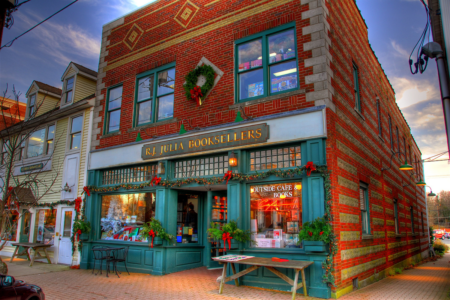
The largest US book-publishing trade show seemed at times to have only one message: for the love of books, we must save the bookstores
“Welcome, book lovers.” That was the kind of warm-and-fuzzy refrain you heard during the sessions at BookExpo in New York City. Everywhere you turned, attendees were reminded that BookExpo had been “reimagined” this year to focus on the needs of booksellers—and the rights fair (the activity hub for literary agents, international deals, and licensing) was held separately, two miles across town.
BookExpo opened with brief comments from Len Riggio, the CEO of Barnes & Noble, who was introduced by Oren Teicher, the CEO of the American Booksellers Association (ABA), which represents independent bookstores. Both men acknowledged that it would have been implausible, just a few years ago, for them to appear jointly in the spirit of cooperation and mutual praise. While the collegiality is indeed admirable, Riggio was almost cartoonish in his continued emphasis on how the world can’t have too many bookstores: apparently his business model for the industry’s future is that more bookstores will stimulate more demand. Riggio also complained that publishers’ book pricing is too high—which was his only real comment (aside from the need to open more stores) about competing with online retail. Michael Cader of Publishers Lunch commented (subscription required), “Online bookselling and ebooks were the little-acknowledged enemy in a speech and a show that have reimagined that such outlets don’t drive half of book sales or more.”
Separately, the ABA announced its new membership numbers, saying they’ve grown by 78 stores to a total of 1,835 members. However, as Cader points out, ABA membership is not an accurate number of independent bookstores in the US, as members include stores such as Half Price Books, Hudson Booksellers, and various gift shops, museum stores, and so on. Cader writes, “In our polling of the ABA member directory—so far we’ve only gotten through 16 states, including many of the most populous, comprising about 1,000 stores—roughly 36 percent are true, independent bookstores primarily selling new books.”
The CEO panel also discussed the primacy of print books—naturally, given the show’s focus on booksellers. The heads of Macmillan, Simon & Schuster, and Penguin Random House (PRH) sat down for a very friendly chat with Maria Pallante, the CEO of the Association of American Publishers. Markus Dohle of PRH offered comments similar to his optimistic and upbeat comments at other shows: “We have fairly stable business models for print and ebook … and we’ve reached a fairly healthy coexistence between print and ebook. Globally, it’s 80-20. That has stabilized the entire book ecosystem. … It’s encouraging and heartening to see in the last 10 years the children’s and YA book categories have been the fastest growing categories.” In addition to establishing a reading habit in young people, the growing juvenile categories are also print dominant, leading publishers to feel confident, at least for now, about the future.
Reidy said that the number of units sold in physical outlets for Simon & Schuster, as a percentage of their overall business, has remained “rock solid,” which she says is a great testament to the booksellers of America. However, she added, “It’ll take more time and focus from all of us to keep it that way.” John Sargent of Macmillan said, “There are some serious issues we will face in the coming years over changing consumer buying behaviors … and the issue of discoverability. … What we need to protect is lots and lots of shelf space in America for people to browse books.” Sargent wondered if it was possible to protect the book-retail ecosystem—if it could continue to thrive as “pressures” come to bear. In a possible counterpoint to all of the happy talk about robust print sales, Carolyn Reidy of Simon & Schuster said, “Mass market is in decline; digital audio is growing. The market has remained; it’s just changed what it wants. How do consumers want the book presented? In what format?”
Bottom line: While not mentioned during the CEO panel, we think pressure is spelled A-M-A-Z-O-N. But at a show like BookExpo, it’s silently agreed that everyone will ignore this elephant in the room. (Amazon did not have an exhibit on the show floor—either for its traditional publishing arm or for CreateSpace/KDP—but it did have a private meeting room and programming events on translation work from AmazonCrossing.) We’re struck by how this key industry show, meant to facilitate business, has become dangerously precious about the role books play in the world. When sessions become an exchange of proclamations about how “books change lives,” one wonders if that’s the ship we’ll all go down on. Even Reidy, during the CEO panel, rhapsodized over how books create empathy in people and are the only medium that can do so, which is of course blatantly untrue.

Jane Friedman has spent her entire career working in the publishing industry, with a focus on business reporting and author education. Established in 2015, her newsletter The Bottom Line provides nuanced market intelligence to thousands of authors and industry professionals; in 2023, she was named Publishing Commentator of the Year by Digital Book World.
Jane’s expertise regularly features in major media outlets such as The New York Times, The Atlantic, NPR, The Today Show, Wired, The Guardian, Fox News, and BBC. Her book, The Business of Being a Writer, Second Edition (The University of Chicago Press), is used as a classroom text by many writing and publishing degree programs. She reaches thousands through speaking engagements and workshops at diverse venues worldwide, including NYU’s Advanced Publishing Institute, Frankfurt Book Fair, and numerous MFA programs.