Paranormal romance is an increasingly versatile subgenre, encompassing mystery/thriller/suspense and urban fantasy with both supernatural and romance plot elements
“When vampires, shifters, or aliens fall in love, there is big money,” says Alex Newton. This month, Newton’s new K-lytics report looks at the latest trends in the paranormal romance category on Amazon, one of the bestselling ebook markets. As a reminder, Hot Sheet is now bringing you these highlights throughout the year; our first installment focused on billionaire romance as well as mystery/suspense/thriller.
Paranormal romance started to take off in the mid-aughts with worldwide interest in the bestselling YA series Twilight. The series was adapted for the big screen and grossed $3.3 billion worldwide, making it the 18th highest grossing film franchise of all time. However, interest peaked around 2012, and traditional publishers started to lose interest. But self-publishing authors did not. They’ve continued to serve existing readers and develop all kinds of new tropes, in addition to blending genres.
That brings us to paranormal romance, a romance subgenre that includes elements beyond the range of scientific explanation, blending together themes from urban fantasy, traditional fantasy, science fiction, or horror. But it still features romance as the core of the plot, which sets it apart from its cousin, urban fantasy, where the main story is action, fantasy, mystery, thriller, or suspense.
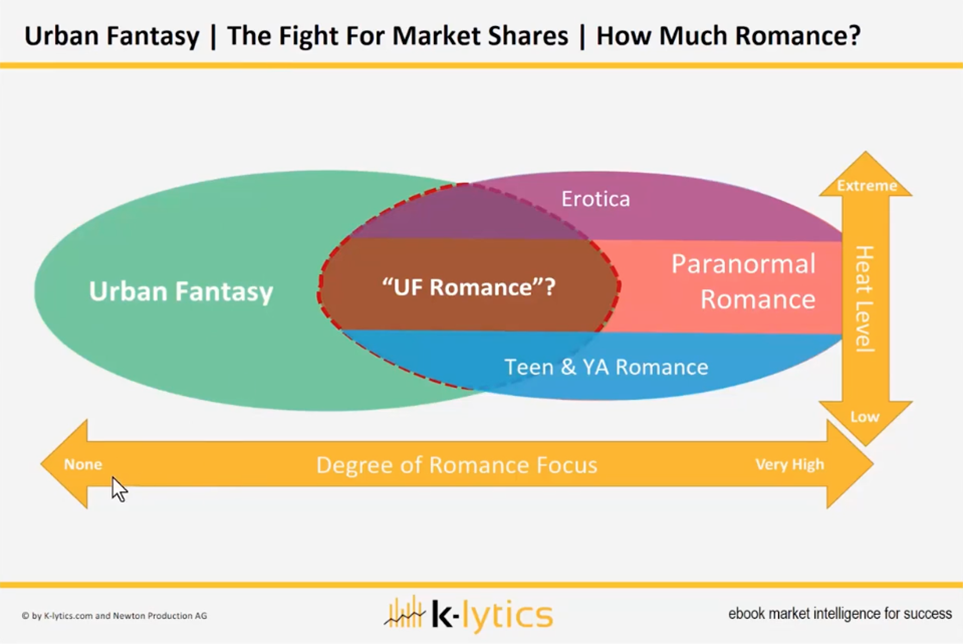
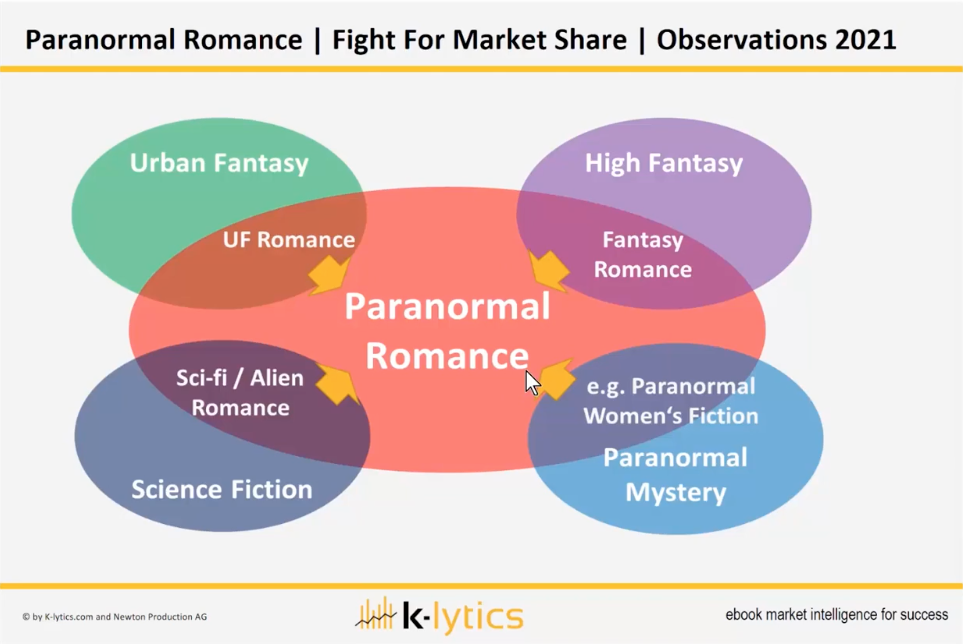
However, the genre boundaries are blurring. Newton showed the following graphs to demonstrate the overlap between paranormal romance and urban fantasy, creating an “urban fantasy romance” category. But the blurring doesn’t stop there. He says authors from other genres also try to claim a share of the paranormal romance market, with a clear trend of high fantasy with strong romance elements entering the mix. (Amazon will even put what should be called fantasy romance into paranormal romance top search results.) Books that fit into science fiction, with alien warriors or shifters, also bleed into paranormal romance. And so on. Thus, Newton says, “It’s not that easy a mission to decide what’s in and what’s out” for the category. For this season’s report, he took a fairly broad definition of the subgenre in line with what Amazon returns for search results.
Because the category has now reached a more mature stage, you can’t just enter the market without research, says Newton. You have to look at what’s resonating with the readers. Currently, around 300 to 350 titles are published per month in the category on Amazon; about three-quarters of the publishing activity is in Kindle Unlimited (Amazon exclusive). It’s a high-performing market with high sales, but high competition. Newton says authors shouldn’t plan for just one book; almost all successful books are part of a series.
Key insights into the paranormal romance category:
- After Hunger Games and the latter part of the vampire romance era (around 2015), there was an almost five-year decline in YA paranormal romance. Then the pandemic hit, and YA sales picked up again. There’s a strong rebound now.
- Some of the “hot niches”—areas of good sales but less competition—include books that include psychics, angels, or ghosts.
- Some of the most competitive and mainstream areas include werewolves and shifters, as well as vampires, witches, and wizards.
- Newly appearing tropes in the category include stories focused on students and academies, as well as elves.
Bottom line: Newton believes that readers’ overall move toward escapist literature since the pandemic started has supported the increasing average sales rank now seen in paranormal romance. But the genre has become very dynamic, with lots of competition. He says of the category, “Gone are the days where you found only bare-chested werewolf shifter men on orange-tinted six-pack-ab cover art.” You can find the full paid report at K-lytics.

Jane Friedman has spent her entire career working in the publishing industry, with a focus on business reporting and author education. Established in 2015, her newsletter The Bottom Line provides nuanced market intelligence to thousands of authors and industry professionals; in 2023, she was named Publishing Commentator of the Year by Digital Book World.
Jane’s expertise regularly features in major media outlets such as The New York Times, The Atlantic, NPR, The Today Show, Wired, The Guardian, Fox News, and BBC. Her book, The Business of Being a Writer, Second Edition (The University of Chicago Press), is used as a classroom text by many writing and publishing degree programs. She reaches thousands through speaking engagements and workshops at diverse venues worldwide, including NYU’s Advanced Publishing Institute, Frankfurt Book Fair, and numerous MFA programs.