Aerio and Zola appeal to niche sellers and those with established audiences who want better sales analytics, more customer data—and more profit
When Bookshop launches next year, we expect it will appeal to many in the literary community who want to support independent bookstores and who will create recommendation lists through the site. What many people don’t realize, however, is that Bookshop’s use of Ingram for inventory and fulfillment is within reach of literally anyone. Free tools exist today to create a customized bookstore tied to your own site or brand—where you in fact earn revenue as the bookseller and not just an affiliate fee.
Aerio and Zola Books allow anyone anywhere to immediately become an online bookseller at no cost. These services have been around for years and are currently used by authors and publishers alike. What they have in common: They allow you to instantly sell, from any point of contact (website, email, social, etc.), any book carried by Ingram, whether print or digital. (Ingram’s catalog includes 15 million titles.) Since you are the bookseller in this scenario, you also determine what discount to offer, if any—but of course the more you discount, the less money you earn. You don’t have to do any work to build the e-commerce functionality or ship the books; you do nothing aside from curate the books you want to sell, whether yours or someone else’s.
Aerio, owned by Ingram, offers several sales and marketing features if you move from a free plan to a paid plan: You can upload your own ebooks to your “inventory” and sell direct—a nice feature for self-published authors. You can also offer unlimited ebook giveaways, create shareable book previews, and collect consumer emails through those giveaways and previews. All of this happens as part of a bookstore you create and customize, but that Aerio hosts. (It is also possible, if not ideal, to embed an Aerio bookstore on your site.) Paid plans begin at $25/month.
Here’s how the money works on Aerio when there’s a sale through your store:
- You “buy” the book from Ingram at the wholesale discount, then resell it with the remaining margin at whatever discount you want. (However, with Big Five ebooks, discounting is rarely allowed.)
- Aerio subtracts 15 percent of the sales price as a fee and an additional 40 cents per unit to cover shipment, taxes, returns, refunds, and customer service. (People who buy books from your store will not be contacting you with any trouble they experience with their purchase, nor are you processing their payment. That’s all handled by Aerio.)
- If you’re a self-published author selling your print edition through this method, you receive payment yet again (but separately) as the publisher—which will dramatically increase your margin.
- For ebooks you’ve uploaded yourself and sell through Aerio, you earn the full margin, but Aerio still retains 15 percent. (Your pricing may not dip below $2.99 for an ebook.)
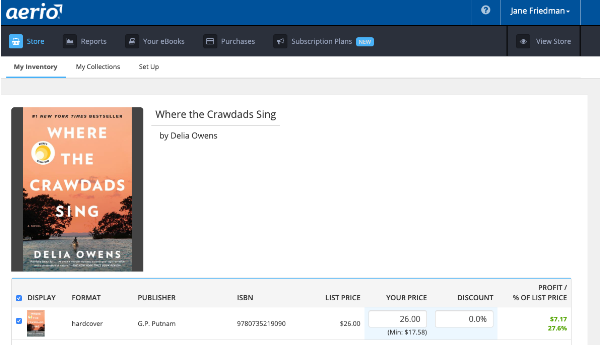
you’ll earn $7.17 as the bookseller, or 27.6 percent of the list price. As a comparison, Amazon regularly sells the hardcover
for less than $15 (usually cheaper than the ebook). Such a low price point with Aerio isn’t possible. In order to remain in the black, the minimum you can charge for this $26 print book is $17.58.
Aerio is meant to be more than an e-commerce tool. When we spoke to Pete McCarthy and Jess Johns at Ingram, they told us that traditional publishers use the marketing features (giveaways and previews) to generate interest and engagement around their content. Plus, with Aerio it’s possible to link to other retailers, if you’re on a subscription plan, to give your customers more options for purchase. (But if a sale happens at another retailer, and not your own Aerio store, you’re no longer the retailer and thus not earning the retailer’s cut of the sale.) Here’s an example of an author using Aerio; here’s Fodor’s using Aerio.
Authors successfully using Aerio are “highly verticalized,” McCarthy says. He says their audience is not just narrow, but super narrow—for example, not just Christian, but a particular type of Christian working on histories in a particular decade—where the author is a specialist and speaking very directly to an audience who knows who they are. He says that authors especially benefit from Aerio when they’re doing speaking gigs, events, or tours and want the ability to offer custom discounts for those audiences. (Aerio allows for discount or promo codes with start and end dates and use limits.) Aerio only sells to the US and Canada and requires a US bank account.
Calling itself The Everywhere Store, Zola Books works like Aerio, but with a few critical differences. First, it’s not necessary to pay for any of Zola’s functionality, as you do with Aerio. Second, Zola’s most important functionality—the widget that sells the book—must be embedded in a website that you already run. If you set up Zola at your site, customers who click the Buy button encounter a widget that takes them through the checkout process so that they don’t ever leave your website. (With Aerio, customers leave your site.) However, Zola also offers book landing pages you can link to, which you’d need for marketing via email. (Here’s an example for Where the Crawdads Sing.)
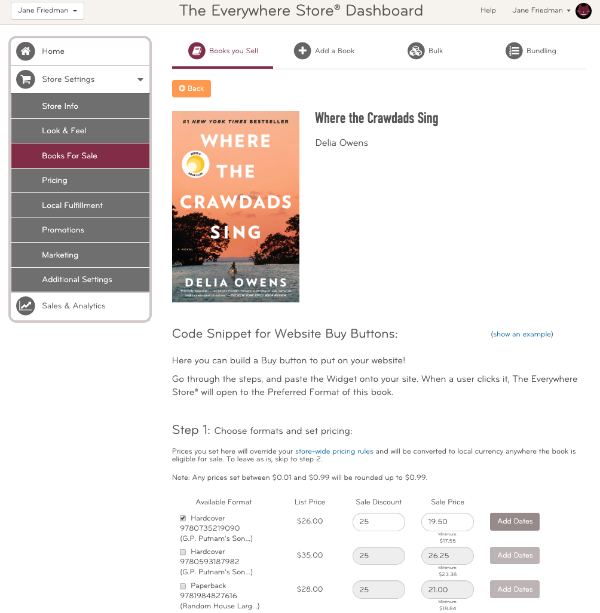
The payout from Zola isn’t as favorable as Aerio’s. In most cases, Zola expects to receive 40 percent of the list price for print books. On that 40 percent take, they charge you a 40 cent unit fee, subtract payment processing fees (around 3 percent of the customer price), then split what’s left with you 50-50. If you sold the hardcover edition of Where the Crawdads Sing using Zola at the full $26 list price, you would net $10.40. After subtracting fees and Zola’s 50 percent cut, you would receive around four dollars and change, compared to $7.17 from Aerio. However, when we spoke to Joe Regal, co-founder of Zola, he says that their conversion rate is phenomenally high, mainly because the Zola sales widget is the product of months of testing with thousands of people. “Our innovation—to stay on the site—is the transformational difference,” he says.
UPDATE: Zola does not use Ingram alone for fulfillment of orders. In a Zola feature called Local Fulfillment, Zola sends print book orders directly to the author, or even to the Zola warehouse, for fulfillment. In such a scenario, authors can earn a high margin (beyond 90 percent), even with Zola fulfilling, assuming the author has print stock.
Zola’s ebook sales happen as a result of agreements with publishers, not Ingram. As with Aerio, authors can sell ebooks direct through Zola.
Zola ships all over the world, but getting paid without incurring additional fees will likely require a US bank account.
The drawback with both of these options? They’re not as easy for customers as Amazon. Anyone purchasing through Aerio- or Zola-powered stores will have to create an account, plus we haven’t even touched on ebook compatibility, storage, and loading issues. Further, your customers won’t see Amazon customer reviews and other elements that can help improve conversion. But the increased profit margin on direct sales might make up for it—plus you’re getting all the insights and data from store activity (including customer email addresses) that Amazon never shares.
Bottom line: We asked Regal about lessons learned as he’s improved Zola. (The first iteration of Zola failed.) He says that, at the beginning, “You don’t fully comprehend what you need to build to sell a damn book.” While he was referring to all the coding and tech required to make Zola work effectively, we think his statement applies to anyone who expects to successfully sell books. Anyone using Zola, Aerio, or the forthcoming Bookshop will need to figure out how to marry best practices in e-commerce with effective methods of getting people’s attention in the first place. Authors need established audiences or platforms to sell books reliably, especially direct. But the more people who are trying to sell, the better, Regal says. “We don’t see it as winner take all. Bookselling is something where there should be a lot of hands.”

Jane Friedman has spent her entire career working in the publishing industry, with a focus on business reporting and author education. Established in 2015, her newsletter The Bottom Line provides nuanced market intelligence to thousands of authors and industry professionals; in 2023, she was named Publishing Commentator of the Year by Digital Book World.
Jane’s expertise regularly features in major media outlets such as The New York Times, The Atlantic, NPR, The Today Show, Wired, The Guardian, Fox News, and BBC. Her book, The Business of Being a Writer, Second Edition (The University of Chicago Press), is used as a classroom text by many writing and publishing degree programs. She reaches thousands through speaking engagements and workshops at diverse venues worldwide, including NYU’s Advanced Publishing Institute, Frankfurt Book Fair, and numerous MFA programs.