In the face of declining membership and controversy, the RWA board attempts to rebuild the organization’s strength
By Emily Wenstrom
| Romance Writers of America (RWA) is the leading organization for a genre that is a force within publishing. Romance titles consist of a third of all book sales and bring in over $1 billion a year—and that was before the pandemic triggered 17 percent growth. Yet, RWA has recurringly experienced explosive public reckonings over systemic racism issues. Although a new board in March 2020 and swift actions for diversity prompted optimism, issues resurfaced when the newly rehauled awards program, the Vivians, resulted in a problematic category winner. Amid these issues, what is RWA’s future? Does it have one? Current board leaders—authors of color who emphasized they know exactly how hard it is for marginalized authors in the industry—still say yes. RWA’s public conflicts have been not only a diversity issue but also an organizational health issue. Membership shrank from 9,259 in 2019 to 6,467 in 2020 to 4,822 in 2021. Over this same period, the number of chapters declined from 110 to 105 to 78. As seen across Twitter, many publicly tied their lapsed memberships to the organization’s diversity issue failures. 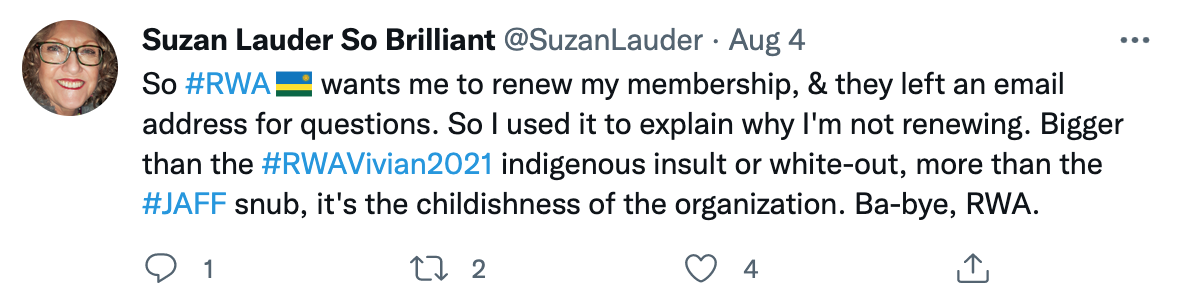   |
The RITA Awards once brought in as much as $100,000 for RWA. But the program was cancelled in 2020 before resetting with the Vivian Awards in 2021. To create a level playing field and encourage entries, 2021 Vivian submissions were free.
“The decision behind that was to help restore the faith, gain awareness of RWA beyond just the people who are already in it, benefit Romancelandia and the publishing industry as a whole … our way of, okay, we’ve retired the RITA. This is the Vivian, this is what it’s meant to do. We want to be inclusive. We welcome all your voices,” said C. Chilove, RWA secretary.
Still, submissions were down, although a portion of this was likely due to a new rule to limit how many books an author could enter. After two years with no awards revenue, RWA expects to return to an entry fee for future years.
Then there’s the annual conference. A major sponsor cancelled due to the December 2019 to March 2020 fallout, even before the event turned virtual due to the pandemic. With this shift, RWA reduced registration fees. Though participation was better than anticipated, the virtual conference brought in about 1,000 participants, compared to the 1,900 to 2,100 attendees that typically attend. The conference will be virtual for 2021 as well.
Meanwhile, a number of the remaining chapters reduced their membership dues. Since a portion of chapter dues is passed on to the national organization annually, reduced dues means reduced funds for both chapters and national.
“There were a lot of our members who, they were seeing what was happening. And they were contemplating, should they stay in the organization? And as leaders, we were contemplating,” said Laurel Cremant, President of the Cultural, Interracial, and Multicultural Special Interest Chapter (CIMRWA). “We didn’t want to tell our members, ‘Hey, we know that this is a crisis of conscience; pay us anyway.’ We wanted to lower it to a point where they could still wait and see with us.”
CIMRWA was one of many chapters that considered disbanding following the events of winter 2019–2020 and even held a member vote that resulted in a decision in favor. But between the time of the vote and the results, the full RWA board had resigned and been replaced, and CIMRWA opted to “wait and see.”
In the aftermath of these impacts, RWA weighed its options. Among these considerations, bankruptcy was explored. “The executive committee discussed the option, but it was just like any discussion. We kind of weighed the pros and cons, and we’re still weighing the pros and cons,” said Leslie Scantlebury, executive director. “It’s not on the table to be done.”
Chilove stated bankruptcy “has never been a formal discussion amongst the board.”
RWA membership continues to be a heated issue among romance authors. In an early August thread in the Authors Guild forums, a romance writer sought to connect with others in the genre as she let her RWA membership lapse. Many weighed in, mostly saying they had also left RWA or intended to. The thread soon turned to the organization’s financial challenges and the “train wreck” of events in the organization’s past. At one point, an Authors Guild moderator reminded contributors to stay respectful as they discussed “some hot-button issues.” Contributors recommended the Authors Guild, NINC, and Women’s Fiction Writers of America as replacements for RWA. Ultimately, the group worked with Authors Guild to create a new romance chapter.
Yet RWA remains a sizable organization, even if not as sizable as in the past. RWA president LaQuette credited the sustained membership to the organization’s connections and pull within the industry and cited Cockygate as an example in which RWA was able to advocate on behalf of romance authors. Liv Rancourt, President of Rainbow Romance Writers, cited RWA’s advocacy for authors with DreamSpinner Press to secure missing author payments as another such example.
“RWA has a larger voice. We can pick up the phone and call Amazon; we can email some of the publishers. That’s not something that some of these small groups can do to advocate on behalf of larger authors’ rights,” said Chilove.
RWA also offers professional network and education opportunities, which current leadership expressed a commitment to building upon with an emphasis on opportunities for marginalized authors. A Pathways Program currently in development will offer authors of color education on how to market their work, approach submissions, and otherwise cultivate a mindset to work with a publisher. Another, Pen to Paper, will educate new writers on the craft of writing romance. Rancourt alluded to another program in development and said she believed Rainbow Romance Writers members “will find it very cool and interesting.”
The board set in place in March 2020 did a “deep clean” of the organization’s policies and procedures and restructured the code of ethics. They created a diversity task force and hired a DEI consultant to provide education to members. Even before the Vivian winners were announced, a task force was scheduled to assess the first year of successes and failings and set a course for continued improvement. “RWA is in no way asking the world to give us a pass. We have made some really great strides. But we also have made some huge mistakes. And we obviously want the opportunity to go back and see where we made the missteps,” LaQuette said.
RWA is hardly the only organization to experience fracturing as a result of a push for diversity, Dr. Christine Larson, assistant professor of journalism at University of Colorado Boulder, observed, citing the film industry, Silicon Valley, and the Women’s March. Within publishing, the Sad Puppies plagued the Science Fiction Writers Association’s (SFWA) Hugo Awards. “Systemic racism and bigotry is baked into the infrastructure of our society. So of course, publishing is going to be the same; of course, any organization like RWA is going to be the same.” said LaQuette. “But my job is not to give up. Because if I give up, they win.”
But some (like this former member) felt the issues with this year’s Vivian Awards were the same problems all over again.
But Larson disagrees.
“I found it heartening to contrast how this board dealt with this controversy, compared to the way the old board dealt with Courtney,” she said. “The board reacted quickly and clearly. They immediately rescinded the award. And that’s very different than what happened in the Courtney Milan controversy … just the fact that this board saw what was wrong and took … quick, strong powerful steps to send a message, I think that says a lot.”
Bottom line: At RWA, the leaders who contributed to this story were less worried about a future without RWA and more worried about a future RWA that didn’t make space for marginalized authors. “If none of us [marginalized authors] are at the table to help make these decisions, the same rules and policies that have been in place for so long will keep us out. So, I have a chance to elevate my voice in a space that has been condemned eminently white,” said Chilove. Where does RWA go from here? LaQuette said: “My goal is to make sure that whatever foundation I’m setting, that it’s strong enough that when the next person comes, they get to continue to build on it until we can see some real change.”
Emily Wenstrom is a freelance writer and platforming expert and writes award-winning speculative fiction for teens and adults as E. J. Wenstrom.

Jane Friedman has spent her entire career working in the publishing industry, with a focus on business reporting and author education. Established in 2015, her newsletter The Bottom Line provides nuanced market intelligence to thousands of authors and industry professionals; in 2023, she was named Publishing Commentator of the Year by Digital Book World.
Jane’s expertise regularly features in major media outlets such as The New York Times, The Atlantic, NPR, The Today Show, Wired, The Guardian, Fox News, and BBC. Her book, The Business of Being a Writer, Second Edition (The University of Chicago Press), is used as a classroom text by many writing and publishing degree programs. She reaches thousands through speaking engagements and workshops at diverse venues worldwide, including NYU’s Advanced Publishing Institute, Frankfurt Book Fair, and numerous MFA programs.