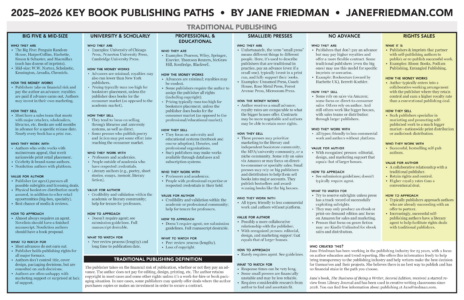
While it’s fairly straightforward to define traditional publishing (publishers pay authors while assuming all financial risk) and self-publishing (the author assumes all risk), an alternative path to publication in the digital era has emerged: it is sometimes called hybrid publishing.
Hybrid publishing can appear like a dressed-up version of subsidy publishing, where the author pays to be published. But the term hybrid was coined to indicate a more selective and supportive publishing approach. Not just any author can walk through the doors of a hybrid and get published; certain standards must be met, as in traditional publishing.
For better or worse, many straightforward pay-to-publish services started calling themselves hybrids as a marketing gimmick, to make them look savvier and more desirable than they were. Authors—who can be susceptible to such marketing—could then feel progressive and proud to work with a hybrid publisher, even though the end result would have little or nothing to distinguish it from your average self-published book.
The Independent Book Publishers Association, established in 1983 to serve small publishers and self-publishing authors, has taken steps to remedy this problem. In February, they released nine criteria that define what a hybrid publisher is. The most notable criteria include:
- A vetted submissions process. In other words, good hybrids reject some authors.
- Adherence to industry standards. Book quality is the responsibility of the hybrid publisher, not the author, and should be on par with traditionally published titles.
- Meaningful distribution. Rather than just uploading book files to Amazon or Ingram and calling it a day, a hybrid should have a strategic approach that involves either traditional bookstore distribution or outreach to specialty/niche outlets. The criteria state, “At minimum, a hybrid publisher develops, with the author, a marketing and sales strategy for each book it publishes … and provides ongoing assistance to the author.”
- Respectable sales. While sales obviously will vary based on category or genre, the criteria state, “Small niches require sales of only a couple thousand copies, while mass-market books require more.”
- Higher-than-standard royalties. This is defined in most cases as more than 50 percent of net on both print and digital books.
The criteria emphasize repeatedly that the hybrid publisher must not abrogate responsibility for quality, which is important in this context. If authors are footing the bill for publication, they may be tempted to cut corners and do things on the cheap, while sacrificing quality. It’s up to the hybrid to maintain quality even in an author-subsidized model—not always an easy job.
Bottom line: The IBPA’s guidelines are welcome and provide an important resource for the entire industry. With time, we hope to see the term hybrid publisher become more consistent and honest in its application. However, we still expect writer confusion and ongoing questions as to what differentiates a hybrid from a self-publishing service provider. The line is not always clear, especially when making judgments of quality. Victoria Strauss of Writer Beware offers more criteria in her comment on an article addressing this topic at Publishing Perspectives.

Jane Friedman has spent her entire career working in the publishing industry, with a focus on business reporting and author education. Established in 2015, her newsletter The Bottom Line provides nuanced market intelligence to thousands of authors and industry professionals; in 2023, she was named Publishing Commentator of the Year by Digital Book World.
Jane’s expertise regularly features in major media outlets such as The New York Times, The Atlantic, NPR, The Today Show, Wired, The Guardian, Fox News, and BBC. Her book, The Business of Being a Writer, Second Edition (The University of Chicago Press), is used as a classroom text by many writing and publishing degree programs. She reaches thousands through speaking engagements and workshops at diverse venues worldwide, including NYU’s Advanced Publishing Institute, Frankfurt Book Fair, and numerous MFA programs.