Even though agents and editors may be attempting to conduct business as usual, the coronavirus undoubtedly affects acquisitions
As the coronavirus hits the epicenter of US book publishing in New York City, writers are correct to wonder: Is now the right time to be submitting my manuscript? Are publishers really making any acquisitions? Should I wait until the storm passes?
The honest answer is: no one really knows what you should do—these are unprecedented times—but the industry will be affected, just like any other consumer retail business. We won’t know for many months how acquisitions and the overall business might change. Agent Janet Reid (known popularly as Query Shark) recently said that her first priorities are upcoming publication dates, manuscript delivery dates, and events—and that she’s very hesitant to offer representation.
However, because some writers have extra time on their hands, agents and editors may see increased submissions. The Guardian reports that several industry professionals are seeing double or triple the rate of unsolicited materials. Possibly editors and agents do have more time to review such submissions—but the situation is complicated.
Agent Kate McKean discusses this challenge at length in her newsletter, Agents and Books: “I know editors, on Twitter at least, are all like We’re reading! We’re buying! Agents, send us books! And that’s great! I love it. There are some editors, possibly those without kids at home, who may have more time to read. I love that, too! But while they might be enthusiastic and excited to read, they don’t have room on their lists to buy 10 more books than usual. Each imprint’s list is not going to expand. It might not necessarily contract, but it’s not like an editor is going to be able to buy six more books a year just because we don’t have to ride the subway to work right now. And while editors might be thinking Hmmmmm, how about something more fun and light? right now, I doubt anyone’s editorial board meetings are trying to predict people’s moods 12–24 months from now. That’s when books we buy today will come out.”
Howard Yoon, a literary agent based in Washington, DC, tells us he’s seeing a direct effect on publishing decisions. “All the publishers are reassuring us that it’s business as usual … [but] I closed on a book deal last week and one of the editors dropped out of my auction at the last minute because she just couldn’t predict where the market would be for the book in 12/18/24 months.” Overall, he’s making decisions on a project-by-project basis, based on the subject matter and whether it seems best to hold off until things feel back to normal. He did fast-track a project because his client, a doctor, is worried the market will only get worse in the coming weeks—and that submitting sooner rather than later will be better for her project.
Agent David Fugate, based in California, says there will be variation in how agents and publishers respond. “Having worked from a home office for 15 odd years now, it’s mostly business as usual from my point of view,” he tells us. “However, I don’t think the same is quite true of publishers, as many of them are still getting accustomed to working remotely while also juggling what to do with books that have imminent pub dates, as bookstores are closing and tours are getting canceled.” Fugate says he is not rushing to pitch anything at this point because it doesn’t feel like the right time. However, he says that feeling is likely to change on a day-to-day and week-to-week basis.
Mary Laur, senior editor at University of Chicago Press, says they are accepting proposals as usual while working remotely. However, “It might take us longer to get to decisions in some cases because of the remote situation,” she tells us. “This is not a good time to submit proposals with imminent or hard deadlines, as with agented projects.”
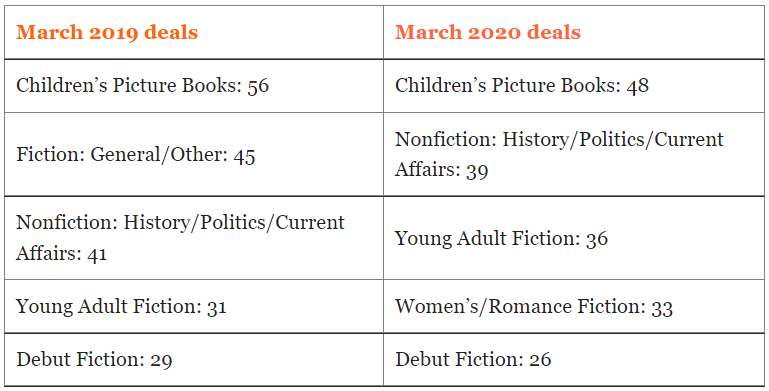
For what it’s worth, we checked the deals database at Publishers Marketplace to compare how many publishing deals were announced this year versus last. While not all deals get announced through this site, it’s a nice gauge of activity nonetheless. In March 2019, you’ll find 1,066 deals total, and in March 2020, 1,004 deals, with the following categories best represented, not counting rights deals.
Bottom line: Yoon’s advice for writers strikes us as right on the money: “Continue to send out to agents and publishers, with the understanding that stuff is taking us longer to process. We are all struggling to juggle that work/home/family balance. I find myself with about three to four hours of work time at best, and then the rest of the time is juggling kids and household.” Also, one thing is fairly certain: Don’t rush to write a novel about a pandemic. As Reid says, it’s too soon. Perhaps you can draw ideas and inspiration from current events as any writer does, but no one wants to see a submission this spring or summer that promises a page-turning novel about a virus that shuts down the world.

Jane Friedman has spent her entire career working in the publishing industry, with a focus on business reporting and author education. Established in 2015, her newsletter The Bottom Line provides nuanced market intelligence to thousands of authors and industry professionals; in 2023, she was named Publishing Commentator of the Year by Digital Book World.
Jane’s expertise regularly features in major media outlets such as The New York Times, The Atlantic, NPR, The Today Show, Wired, The Guardian, Fox News, and BBC. Her book, The Business of Being a Writer, Second Edition (The University of Chicago Press), is used as a classroom text by many writing and publishing degree programs. She reaches thousands through speaking engagements and workshops at diverse venues worldwide, including NYU’s Advanced Publishing Institute, Frankfurt Book Fair, and numerous MFA programs.