
We work with Alex Newton of K-lytics to bring you a high-level look at publishing trends based on what’s currently being read and sold at Amazon. These trends relate strictly to the Kindle ebook market, where Newton has been tracking sales rank data since 2014.
Last month, Newton released his annual report on the romance category, reviewing performance of more than 100 categories in romance—what’s growing and what’s declining—and other trends. This year’s analysis is particularly interesting because of Amazon’s own changes to the storefront and the romance category hierarchy.
For those who need to catch up: In 2023, Amazon made sweeping changes in how books get categorized and how many categories self-published authors can apply to their titles. Rather than mirror publishing industry BISAC codes, Amazon now requires authors to use Amazon’s own store-driven category selection. In November 2023, modern, trope-based subcategories were added, as seen in the diagrams below from Newton’s presentation.
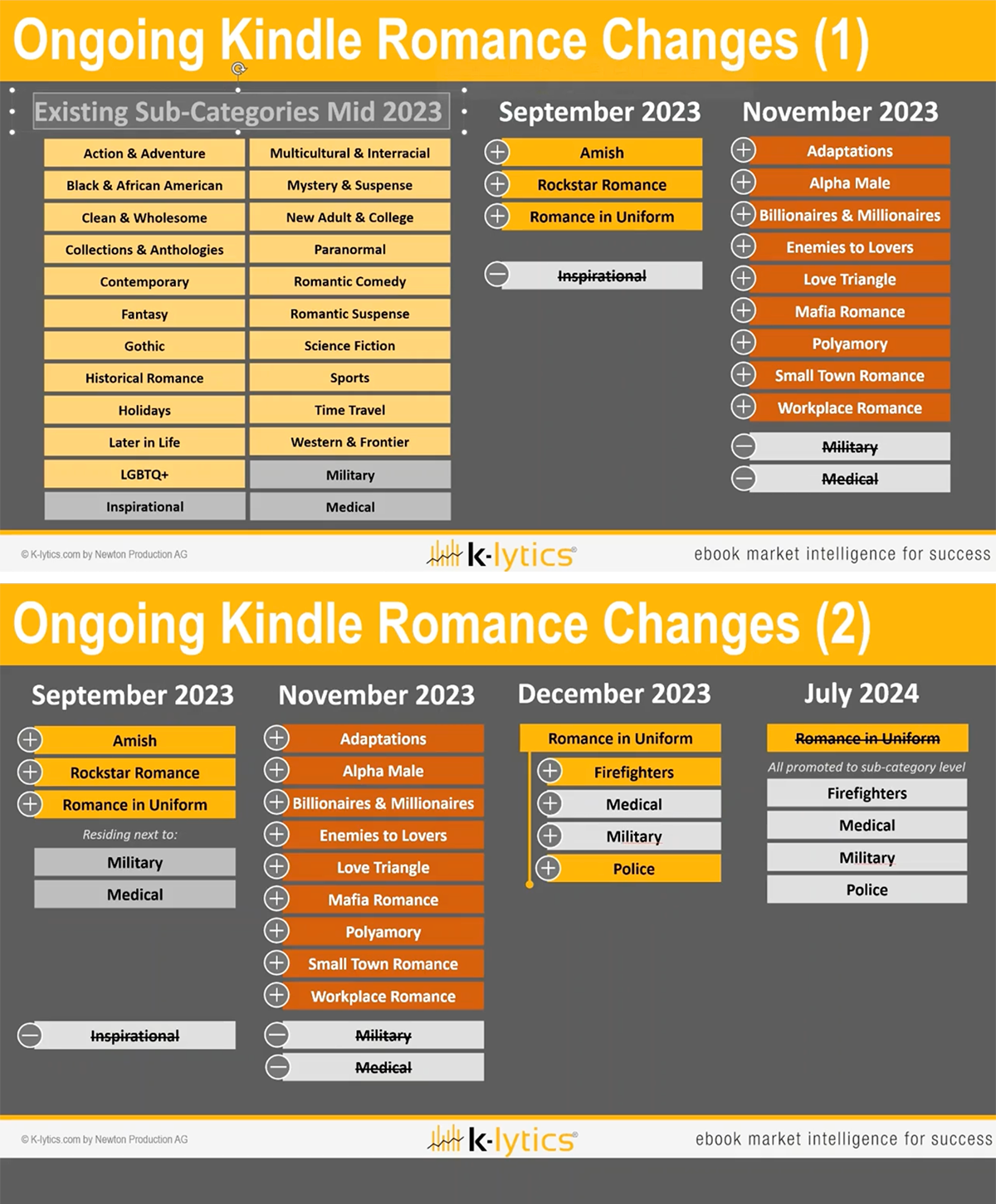
The upshot of these changes: The romance genre now has 35 subcategories, up from 20. In fall 2023, Amazon asked authors in a survey what they thought about the existing store categories, and Newton speculates that, particularly in the romance category, “whoever shouted the loudest got served.” When you combine that with Amazon developers likely making changes rather than people with genre expertise, there have been some moments of confusion. (For example, as shown in the charts above, romance in uniform was added as a new romance subcategory, then later removed.)
The hottest submarket continues to be fantasy romance, otherwise known as romantasy. Other leading subcategories in sales volume include contemporary romance, romantic comedy, billionaires & millionaires, and sports. Later-in-life romance has grown 67 percent in the last year and overlaps in some cases with women’s fiction and beach-read titles. Small-town romance is also seeing growth. Newton says, “Your small-town romance on Netflix [like Virgin River], these things do have an impact on the book market.” Some romance niches with good sales-to-competition ratios include sports, mafia, polyamory (e.g., reverse harem or why choose), gothic, bisexual, and workplace.
Trending down: Paranormal romance—especially dealing with angels, which has the highest rank deterioration of any romance subcategory at 89 percent. This negative trend can be found in many paranormal romance categories. Science fiction romance in the vein of Ruby Dixon’s Ice Planet Barbarians series is also declining.
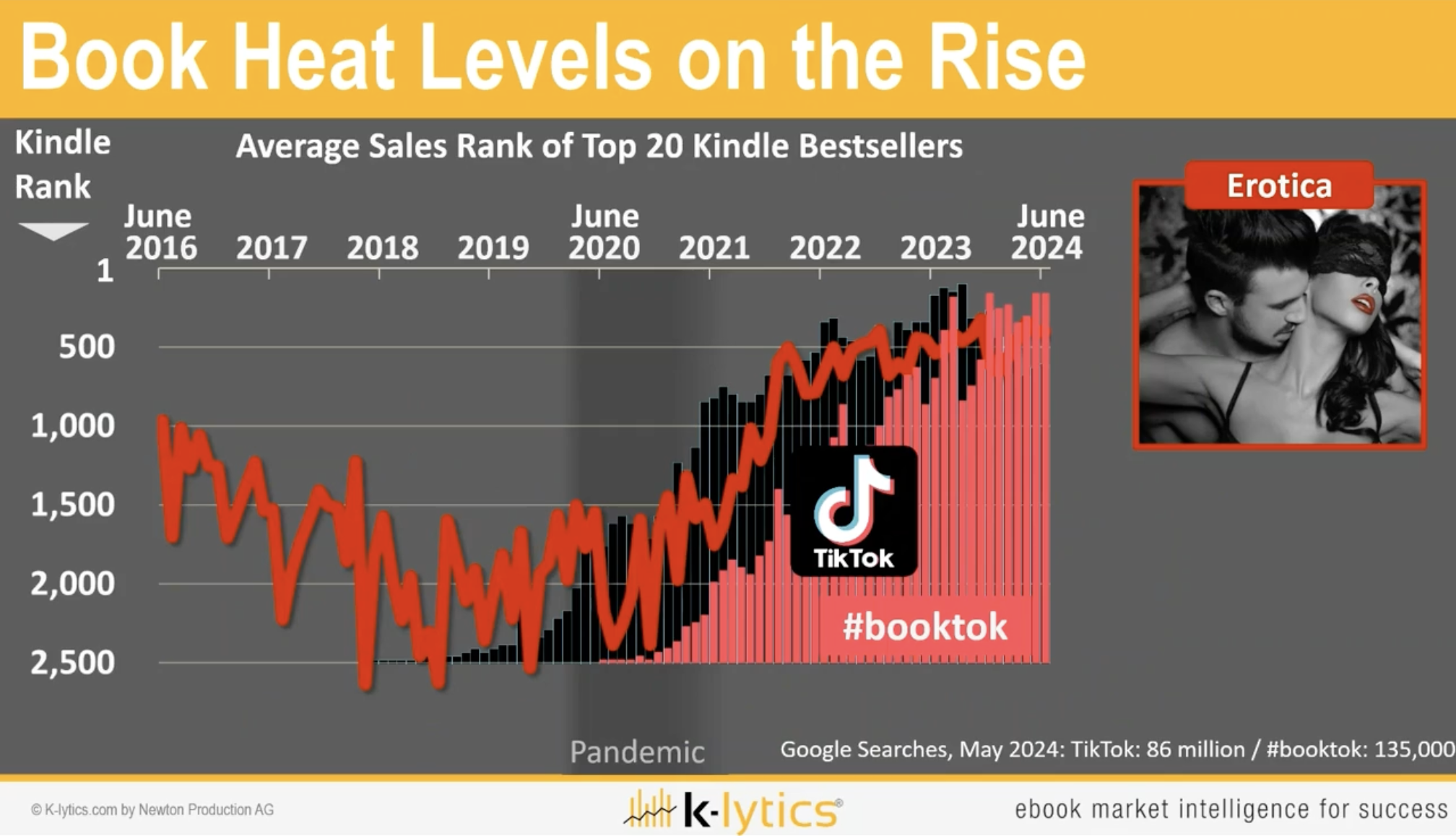
Growth in erotica parallels interest in #BookTok, says Newton. Partly he attributes this to how authors and publishers can bypass the Facebook and Amazon advertising restrictions on erotica. “You can get away with quite a bit [on TikTok] with steamier [organic] posts,” and drive traffic to erotica books on Amazon Kindle.
Other points of interest in the romance market:
- Before the pandemic, the romance category would experience seasonal lows in January, but Newton observes a new pattern: one of continued growth. Seasonal lows have become negligible.
- Ebook prices for romance have risen over time, from an average of $4.99 in January 2023 to $6.15 in July 2024, the highest point over the last 18 months.
- 80 percent of successful books in romance are part of a series.
- Ebook supply for romance has grown by 23 percent in the last 12 months; Newton believes this is partly attributable to generative AI tools. However, while there was an acceleration of new books toward the end of 2023, the trend line is moving back to normal overall growth of new Kindle titles hitting the store.
For those seeking comprehensive detail, Newton offers a paid report on the romance category.

Jane Friedman has spent her entire career working in the publishing industry, with a focus on business reporting and author education. Established in 2015, her newsletter The Bottom Line provides nuanced market intelligence to thousands of authors and industry professionals; in 2023, she was named Publishing Commentator of the Year by Digital Book World.
Jane’s expertise regularly features in major media outlets such as The New York Times, The Atlantic, NPR, The Today Show, Wired, The Guardian, Fox News, and BBC. Her book, The Business of Being a Writer, Second Edition (The University of Chicago Press), is used as a classroom text by many writing and publishing degree programs. She reaches thousands through speaking engagements and workshops at diverse venues worldwide, including NYU’s Advanced Publishing Institute, Frankfurt Book Fair, and numerous MFA programs.
