One of the workshops at Digital Book World (DBW) focused on research that Jellybooks’ Andrew Rhomberg is conducting on consumer reading patterns. You may have heard about this research because right after DBW the New York Times published a piece—titled “Moneyball for Book Publishers,” by Alexandra Alter—that caught the attention of many inside and outside the industry.
In Alter’s take on it, Rhomberg “wants to be the Billy Beane of the book world,” bringing analytical insight to how books are being read, as Beane in the film Moneyball brought analytics to baseball.
Rhomberg’s research can tell us such things as:
- Most readers who get to page fifty or one hundred of a book will make it to the end.
- Some 90 percent of readers tend to give up after just five chapters.
- Readership rapidly declines during the first one hundred pages of a book.
The research is paid for by publishers who want to know how their authors’ books are performing, and Rhomberg has tested some 200 titles for seven publishers so far. Amazon’s Kindle and Apple’s ebook ecosystem can track similar data in reader usage, but that data isn’t being shared with publishers. (And yes, Rhomberg does have readers’ permission to use their anonymized data.)
For authors, of course, this kind of research may be troublesome: publishers suddenly have ways to know that a book may not be read well. Might that affect contract renewals?
At Digital Book World’s site, Rhomberg says that a key question debated at the German publisher Piper Verlag, which used his research, was “Should we tell our authors?”
Piper decided against telling authors about the experiment, Rhomberg writes, “as is true for every publisher Jellybooks has worked with to date. The fear is that poor data could cause authors to worry that the publisher might use the data to rewrite the book—that an author’s standing with their editor could be diminished.”
And when we reached Rhomberg in London, we wanted to know if there’s a Jellybooks analytics mechanism available for self-publishing authors.
“We don’t have a reader analytics solution for self-published authors right now,” Rhomberg says. “The business model of a self-published author (or micro-press) is very different from [that of] a publisher, who needs to allocate resources to a portfolio of titles and understand how to best to promote and position each title in the trade, in the press, through direct-to-consumer channels, and similar. We are thinking about how reader analytics services for authors might work and have a couple of ideas, but it will take some time for these to mature. We need to go beyond ‘nice-to-look-at’ data to something that is actionable and delivers tangible results for an individual title, just as we do for large publishers.”
Furthermore, Rhomberg says, publishers are more inclined to do pre-publication testing than authors. “The concept of tests with advance reader copies prior to publication doesn’t really work [for self-publishers], yet that is a cornerstone of our service for publishers. It highlights how different publishing and marketing strategies are between traditional publishers and self-published authors. It took us eighteen months to fully understand the workflow,” of the participating publishers who aren’t telling their authors that their books are being tested.
Bottom line: While it’s understandable that authors may be concerned when their audience’s reading patterns are revealed to a publisher by this kind of technology, such analytics are not only inevitable but also can be useful. Authors, like publishers, benefit from knowing that there are problematic aspects of books that might cause readers to disengage prematurely.
We hope publishers arrange to test books with Jellybooks’ technology and share the results with authors. That way, there’s no secretive quality to the process, and the publisher-author partnership could be enhanced as reader reaction is studied and evaluated.
Below, with permission from Rhomberg, we leave you with a look at how granular his data can be, comparing completion rates for three female readers. This is the kind of information that makes both authors and the industry more knowledgeable—when shared.
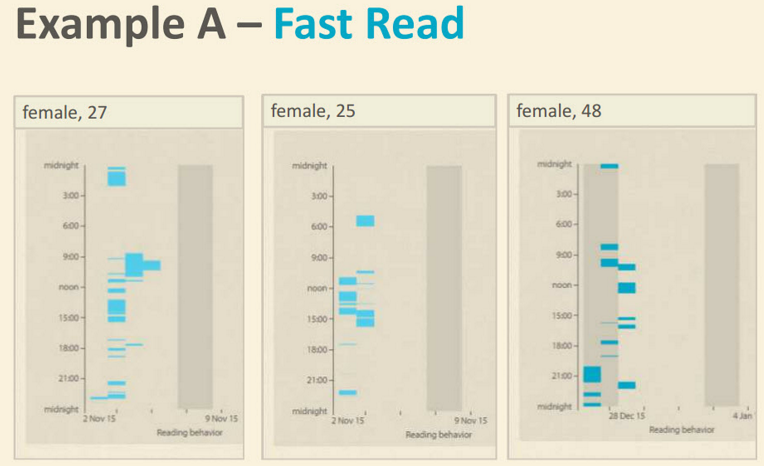
In this screengrab from the Candy for Publishers product from Jellybooks, many factors come into play in what we see. (1) Light blue indicates reading on a mobile device (smartphone); darker blue (as in the right-hand instance) indicates reading on a tablet. (2) We see seven-day grabs in the left and center instance, nine days in the third. (3) Each column represents a day. (4) The shaded areas are weekends. (5) The unnamed title used in these three tests is a romance novel with a completion rate of more than 80 percent and a very high “velocity” rating, which refers to the median reading time for completion (less than four days). (6) The center example shows what appears to have been the fastest read—two days. The twenty-seven-year-old reader on the left was engaged over four days, and the forty-eight-year-old reader on the right over three days.
Rhomberg adds that the slowest median completion rate observed so far is forty-two days for a nonfiction title, nonfiction generally being read more slowly than fiction. And he says that the tests have shown romance to be popularly read on smartphones.

Jane Friedman has spent her entire career working in the publishing industry, with a focus on business reporting and author education. Established in 2015, her newsletter The Bottom Line provides nuanced market intelligence to thousands of authors and industry professionals; in 2023, she was named Publishing Commentator of the Year by Digital Book World.
Jane’s expertise regularly features in major media outlets such as The New York Times, The Atlantic, NPR, The Today Show, Wired, The Guardian, Fox News, and BBC. Her book, The Business of Being a Writer, Second Edition (The University of Chicago Press), is used as a classroom text by many writing and publishing degree programs. She reaches thousands through speaking engagements and workshops at diverse venues worldwide, including NYU’s Advanced Publishing Institute, Frankfurt Book Fair, and numerous MFA programs.