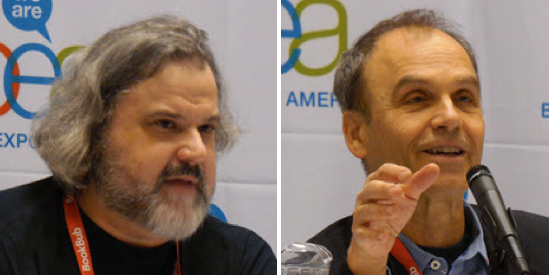
In this space we normally bring you someone you’re likely not to have encountered yet. But you could be forgiven for thinking that authors Joe Konrath and Scott Turow were new finds in their panel appearance at BEA in Chicago. Authorship in the Digital Age was staged in association with the Authors Guild. Jon Fine, formerly of Amazon and Knopf, moderated, and author Barbara Freethy (still the leading Kindle Million Club seller with more than 6 million books sold) did her usual helpful job of sharing frank, clear-eyed insight into her transition from a trade author to a top indie bestseller.
The surprises were in the commentary offered by Konrath and Turow. Neither is known to mince words. Konrath in the past has been sharply critical of Turow, who is former president of the Authors Guild. For his part, Turow is seen by many in the indie camp as bolstering the trade industry as a financially beneficial business for marquee authors.
Turow seems to have leavened his opinions with a deeper understanding of where—he says—publishers are failing to meet the needs of many authors. Publishers “deliver less of what seems to make traditional publishers worthwhile to a greater and greater number of authors,” he said. “Instead, they just put authors on a sink-or-swim model. They give very, very little editorial advice. They spend nothing on marketing… I constantly get into this fight with friends in publishing, saying, ‘You guys don’t realize you’re killing yourselves.’
“Publishers, if they want to survive,” Turow said, “have to make publishing inviting for a much greater family of authors.” That reference to family was interesting: Turow’s daughter, Eve Turow Paul, is the author of the millennial-foodie book, A Taste of Generation Yum, which she has self-published, he told us.
And Konrath, for all his success in the indie sector, pointed to the kind of luck that Scott Turow was talking about. His message was that most authors won’t have the choice to build a bestselling trade career like Turow’s. “If you want to reach the most people possible,” he said, “you sign with one of these big publishers… [But] most of us don’t get that invitation to the big show.”
Having to use three pen names because his publisher wouldn’t allow him to produce more than one book a year, Konrath taught himself to use self-publishing to go independent, eventually making $80,000 per month.
Rather than position this as a rebel yell, though, Konrath contextualized the experience as being born of necessity. (It’s worth pointing out, too, that Konrath recently took the step of congratulating the Authors Guild’s Fair Contract Initiative when the Guild joined forces with an international cohort of author-advocacy groups. Having been critical of the effort at the outset, his note of recognition for the effort took a bit of courage.)
“We don’t all get the choice,” he said, to become a trade publishing success. “I have a good friend, [author] Blake Crouch, I just bumped into him here at BEA. He’s got a four-story banner hanging right over the registration desk for Dark Matter” from Crown. “His dream came true there. He got the seven-figure deal, he got the big push from a publisher. But you can’t go after that unless you have the opportunity given to you… But we’re not all offered that.”

Jane Friedman has spent her entire career working in the publishing industry, with a focus on business reporting and author education. Established in 2015, her newsletter The Bottom Line provides nuanced market intelligence to thousands of authors and industry professionals; in 2023, she was named Publishing Commentator of the Year by Digital Book World.
Jane’s expertise regularly features in major media outlets such as The New York Times, The Atlantic, NPR, The Today Show, Wired, The Guardian, Fox News, and BBC. Her book, The Business of Being a Writer, Second Edition (The University of Chicago Press), is used as a classroom text by many writing and publishing degree programs. She reaches thousands through speaking engagements and workshops at diverse venues worldwide, including NYU’s Advanced Publishing Institute, Frankfurt Book Fair, and numerous MFA programs.