At the annual Writer’s Digest Conference, a sales and marketing consultant offered a step-by-step process for market research and finding your readers
The 2019 Writer’s Digest Annual Conference featured a wide-ranging program that included several insightful sessions on marketing strategy and tactics. In “Beyond Comp Lists: Market Research for Novelists,” New Shelves Books’ Amy Collins demonstrated how to identify the successful authors in any genre and develop an action plan to find and engage their readers.
“Market research is a very dry, dull topic, but finding and connecting with readers is how we make money,” she said. Too often, market research is limited to the basics—high-level demographics (age, gender, income) and/or broad genre interests (science fiction, romance)—leading to target audiences that either don’t actually exist or, worse, reflect the researchers’ personal interests. To find the right readers for a specific book or author, Collins urges writers to set aside personal assumptions and dig deeper.
“Nobody needs your book. … Everybody doesn’t read.” Citing data from the US Census Bureau and Pew Research, Collins posited that an avid reader lives in a household that purchases nine books per month, and there are only approximately 7 million US citizens who could be considered avid readers. In order to identify the right readers for a specific book—and make money—you have to find the avid readers who actually read and buy books like yours.
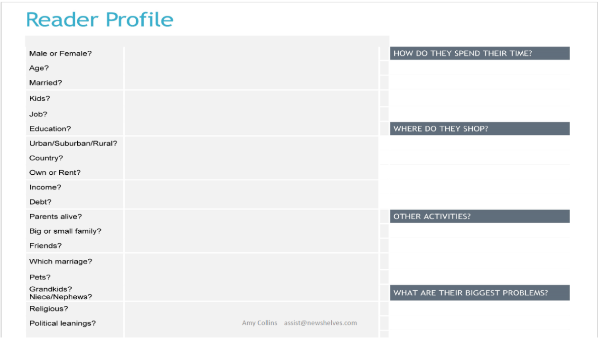
“The smaller your target, the easier it is to hit.” Collins’s market research process begins with developing a detailed profile of a single reader, setting aside as many personal assumptions and biases as possible. “You are not your readership,” she cautioned. From basic demographics to detailed psychographics, the goal is to craft a three-dimensional sketch of one specific reader who would likely buy your book. “Once you have made up a human being, how do they spend their time? Where do they shop? What are their biggest problems?” This profile will evolve, especially once your book starts to sell and you can analyze your actual readership. But it’s a more effective reference point than something generic like “Millennial sci-fi readers.”
The next step in Collins’s process is to create a list of 24 comparable authors based on what books your ideal readers are likely reading right now. “The people who would love your book—what are they reading now? Who’s on their bedside table?”
- Identify at least three authors your profiled reader currently enjoys, and search each of them on Yasiv.
- For each of those three authors, click on their most popular book from the results, and confirm its genre/category relevance to yours. (For multi-genre authors, choose the most popular title that is relevant to your book’s genre/category.) Identify three new authors from Yasiv’s “Customers often buy” results. Repeat for your other two authors, which should give you a total of 12 comp authors.
- From Yasiv, click through to the Amazon product page for your authors’ most popular relevant titles, scroll down to the “Amazon Best Sellers Rank” in the Product Details section, and click through to their best performing category that’s relevant to your book.
- Add the best-selling author in each category to your comp list—one for every author on your Yasiv list—for a total of up to 24 comparable authors.
- To flesh out your 24 comps, use USA Today’s Best-Selling Books list, filtering by the relevant genres, to identify any relevant authors you may have missed.
- Monitor these bestseller lists periodically to identify new comp authors and trends in the market.
“Other authors are not your competition,” Collins explained. Your next step is to connect with each one of the writers on your unique list of 24 comparable authors. Join their communities, follow them on social media, sign up for their newsletters, and read and review their books on your own platform(s). Read other reviews of their books and make a list of potential reviewers for your own book. Identify their superfans; follow and engage with them. Engaging with your comp authors and their readers will help you develop organic relationships, evolving your understanding of your own potential readership while enabling you to build a list of truly engaged reviewers and readers who will be interested in your book when you’re ready to start promoting it.
Bottom line: Real marketing is more involved than simply having a platform. Collins’s in-depth process offers a practical approach that authors don’t have to spend money on, and it addresses the challenge of how to build and manage an effective platform by focusing on the readers you’re building it for.

Jane Friedman has spent her entire career working in the publishing industry, with a focus on business reporting and author education. Established in 2015, her newsletter The Bottom Line provides nuanced market intelligence to thousands of authors and industry professionals; in 2023, she was named Publishing Commentator of the Year by Digital Book World.
Jane’s expertise regularly features in major media outlets such as The New York Times, The Atlantic, NPR, The Today Show, Wired, The Guardian, Fox News, and BBC. Her book, The Business of Being a Writer, Second Edition (The University of Chicago Press), is used as a classroom text by many writing and publishing degree programs. She reaches thousands through speaking engagements and workshops at diverse venues worldwide, including NYU’s Advanced Publishing Institute, Frankfurt Book Fair, and numerous MFA programs.