Professional authors usually consider two things indispensable to their marketing and career growth: an author website and an email newsletter. For self-publishing authors especially, these two items are near impossible to do without. But after that point, what’s the most popular marketing investment? Usually, it’s a service that helps facilitate giveaways (sometimes known as a reader magnet) and email newsletter signups.
In this issue, we’re going to focus on two such services: BookFunnel (the longstanding choice) and StoryOrigin (the newest option).
BookFunnel
BookFunnel was founded about five years ago by fantasy indie author Damon Courtney; its primary function is to help self-publishing authors deliver ebooks directly to readers and build an email newsletter list. (If you’re wondering what traditional publishers use, see NetGalley.)
Indie authors using BookFunnel typically prioritize the following marketing strategies:
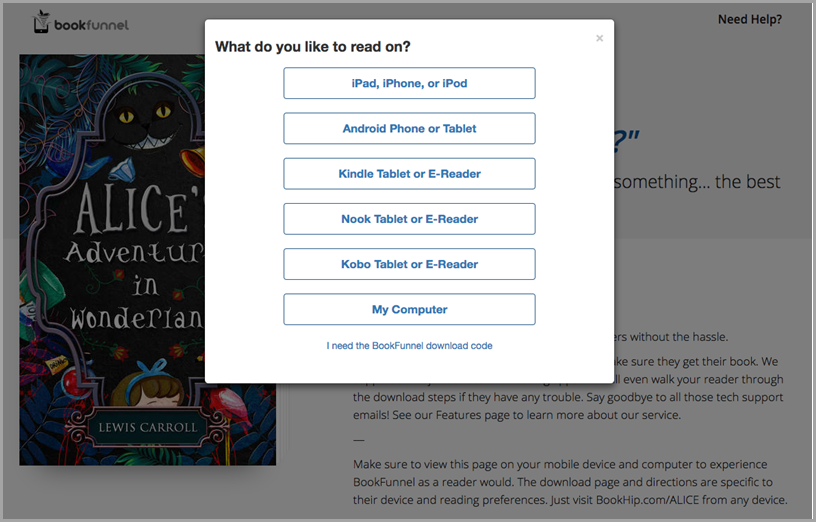
- Reader magnets. This is where authors offer a free ebook of some kind in exchange for a reader’s email address. BookFunnel helps streamline the process of making these ebooks available (across multiple formats) and delivers them securely. You can set limits on the number of downloads available, set the download to expire after a certain time, and receive real-time stats about who is downloading. BookFunnel handles all customer-service issues, like when your readers have trouble downloading your ebook or loading it onto their device.
- Advance review copies. You can send ARCs to reviewers using BookFunnel’s “certified mail” delivery. You can track who downloaded the ebook, send reminder emails, and more.
- In-person marketing with discount codes. You can generate unique codes to distribute at conferences or other in-person events; the codes allow readers to download an ebook for free. Once the code is used, it is void.
- Fulfillment and customer-service support for direct ebook sales. If you use PayPal, Payhip, Selz, Shopify, or WooCommerce to sell ebooks direct through your site, you may be able to use BookFunnel to help fulfill those orders and help with customer service.
BookFunnel pricing is based on the number of ebook downloads that happen in a month; the more expensive plans have higher limits and also include more features and integrations. On the cheapest plan ($20/year), you get up to 500 downloads per month, but you can’t collect email addresses or do much else. Such a plan would be most appropriate for an author doing an ARC campaign and not a reader magnet.
It helps to understand what BookFunnel is not, especially when comparing it to other services. BookFunnel itself is not a marketing or promotional service. Rather, it’s a tool that helps facilitate an author’s own marketing and promotion efforts. It does not assist authors in finding readers or promoting ebook giveaways, nor does it own the email addresses that get processed through its system—those belong to you.
That said, BookFunnel does offer a Promotions board to help you find other indie authors with whom you can cross-promote. Using BookFunnel’s tools, a group of authors can create private bundles or multi-book landing pages. BookFunnel also offers a “reputation score” (based on their own internal data) to help promo organizers identify authors who adequately support the promos they join.
StoryOrigin
The new kid on the block, StoryOrigin, is still in beta and remains (so far) free to all; it was founded by Evan Gow, who has a background in private equity and investment banking. On the surface, Story Origin’s key functionality looks quite similar to that of BookFunnel: it helps facilitate the distribution of reader magnets and review copies. But it goes a step further in a couple key areas and has more of a focus on selling, not just giving away:
- In addition to helping authors with group promotions, StoryOrigin helps authors coordinate newsletter swaps. This is where authors swap mentions of each other’s book in their respective email newsletters.
- There are also specific group promotions focused on gaining book reviews, boosting retail sales, and increasing page reads through Kindle Unlimited.

Advanced features involve affiliate marketing and use of the Facebook pixel, as well as basic features that leave us scratching our head, given that StoryOrigin is a marketing site (e.g., goal trackers for making your word count on your manuscript).
When it comes to deciding between BookFunnel or StoryOrigin, most serious indie authors use both or switch between them. Indie author and podcaster Kirsten Oliphant, who writes clean romance under a pen name, says of these services, “I find them both invaluable. I could run my business and do my author things without them, but they offer several services that I use every week. … [T]he reader magnets have garnered me thousands of emails for new, genre-specific readers. I also distribute ARCs this way, making it very easy for my readers to sideload the books onto their device without a headache or having to list out specific steps or hand-hold non-tech-savvy readers through the process.”
Furthermore, Oliphant says both services care about the author community and are responsive. “I emailed BookFunnel about a feature I wished they had. Within a month, they added it. … Evan from StoryOrigin is similarly interested in what authors want and need and is always asking for feedback to make his software better.”Bottom line: For more advice on how to strategically and effectively use these services‚ especially reader magnets, consider listening to a couple recent episodes of the Six Figure Authors podcast: Episode 17 features the founder of BookFunnel; Episode 15 features the founder of StoryOrigin.

Jane Friedman has spent her entire career working in the publishing industry, with a focus on business reporting and author education. Established in 2015, her newsletter The Bottom Line provides nuanced market intelligence to thousands of authors and industry professionals; in 2023, she was named Publishing Commentator of the Year by Digital Book World.
Jane’s expertise regularly features in major media outlets such as The New York Times, The Atlantic, NPR, The Today Show, Wired, The Guardian, Fox News, and BBC. Her book, The Business of Being a Writer, Second Edition (The University of Chicago Press), is used as a classroom text by many writing and publishing degree programs. She reaches thousands through speaking engagements and workshops at diverse venues worldwide, including NYU’s Advanced Publishing Institute, Frankfurt Book Fair, and numerous MFA programs.