An exuberant market for online literature leads to investment in Inkitt’s serial fiction app, Galatea
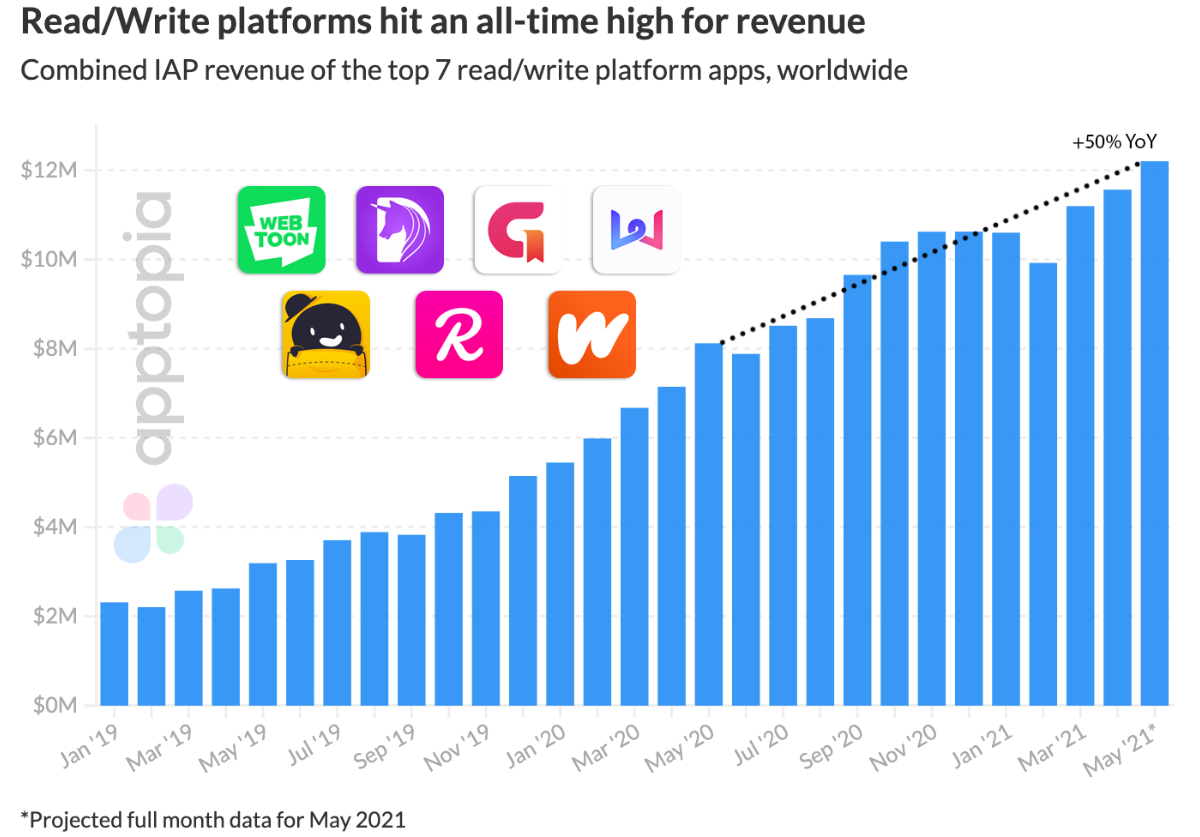
Founded in 2013, Inkitt is a Berlin-based digital publisher that’s similar to online literature platforms Wattpad, Radish, and Webnovel. Such sites and apps have been attracting considerable investment and acquisition by media and tech companies, particularly in Asia. According to Apptopia, reading and writing platforms have hit an all-time high for revenue this year.
This latest funding round for Inkitt includes $59 million on top of $21 million raised previously—with investment from the owner of Macmillan, the former CEO of Penguin, and media and tech company Axel Springer. This funding arrives as Inkitt enjoys success with its “addictive” reading app, Galatea, which represents its most important pivot so far.
Inkitt’s initial goal was to identify bestselling books and authors using its own proprietary algorithm. To attract writing talent, Inkitt ran no-entry-fee writing contests promoted with headlines such as “Free Novel Contest: Submit & Win A Publishing Deal.” Once contest winners were identified using the algorithm—which analyzed reader reaction to the stories—Inkitt would then pitch traditional publishers with the project, taking an agent’s commission for any signed deals. (The only project we can find that achieved that goal is Erin Swan’s Sky Rider series, which was placed with Tor Teen.) If no book deal materialized, Inkitt would then publish and support the novel with its own marketing campaign, primarily focused on Amazon sales.
Along the way, writers were inundated with unsolicited marketing messages from Inkitt, who used social media and emails to publicize their contests for writers. The spammy behavior became so notorious that Victoria Strauss of Writer Beware looked further into the company in 2016. When she examined their book publishing contract, she raised a red flag. To Inkitt’s credit, they did modify their contract to address the concerns. (More on that later.)
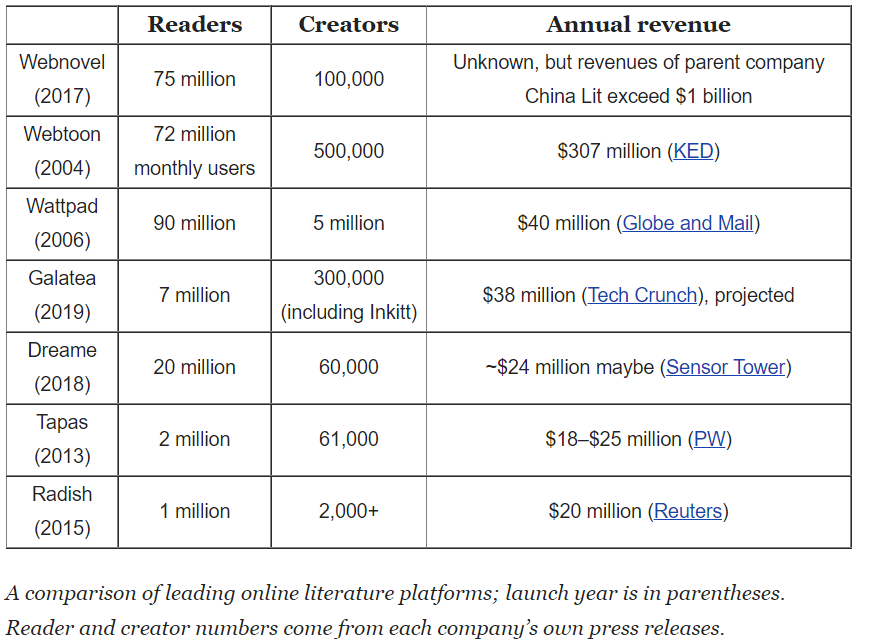
As platforms like Wattpad gained market strength in the 2010s—and secured those coveted deals with New York publishers, along with Hollywood partnerships—Inkitt was not enjoying the same success. It had a large stable of writers and was attempting to monetize their work through its own book publishing arm. And as we all know, profitable book publishing is hard. Inkitt turned its attention to a different business model. In January 2019, it launched a reading app, Galatea, which now has 7 million readers. Inkitt’s algorithm is still touted as the company’s unique strength, as it determines which stories go from free to paid.
However, some users complain that reading through the app can be more expensive than reading ebooks. After finishing a chapter, the app makes readers wait six hours for the next installment unless they pay with points to continue. One reader comments, regarding the most popular series on the app, “This could be a good read if I were allowed to enjoy it, but by the time the app finishes nickel-and-diming me I will have spent enough to buy 10 real books! I’m not about to do that!” Other readers express similar frustration. There is an alternative: Buy Galatea’s unlimited reading subscription for $59.99/year.
In 2018, Inkitt reached out to its stable of authors about Galatea and its new approach, explaining that their in-house staff writers would transform existing works into bite-size episodes for the app. This echoes something of the Radish playbook, since 90 percent of Radish’s revenue comes from Radish Originals, an in-house collaborative program to create intellectual property. However, a number of authors stepped away from Inkitt at that point, as they’d become wary of its business practices. Author Lauren Garcia spoke up about her experience with Inkitt before Galatea became the publisher’s focus.
Inkitt has started showcasing its successful authors through a series of author interviews at its blog. Soumiya Seemran Sahoo, who lives in an impoverished area of India, is one of them; her stories have grossed $2.7 million for Inkitt. Her Galatea work first appeared at Wattpad and became a hot story with 20 million reads; it was taken down, in part, after the Galatea release. The opening of her story remains on Wattpad to lead people to the Galatea version. Some readers are not pleased, even saying they prefer the original version. (Sahoo has about 13,000 followers on Inkitt, compared to 71,000 on Wattpad.) This isn’t a new phenomenon. Wattpad’s competitors, especially Webnovel, have actively reached out to Wattpad writers to get them onto their own platform—read more on this in our April 2021 article.
Inkitt’s most successful author is Sapir Englard, an Israeli who attends Boston’s Berklee College of Music and writes a werewolf romance series. Like Sahoo’s, her work is also on Wattpad, now in abbreviated form, with millions of reads, directing people to Galatea for the full work. A Boston Globe article from May 2021 says Englard was earning $15,000 per month at the peak of her success on Galatea, while a TechCrunch article reported that Englard has earned $8 million so far. We asked Inkitt to clarify this point, and they confirmed that Englard’s stories have grossed $8 million—that’s not what she earned. However, they told me that Sapir’s royalties have continued to grow since the Globe article.
We asked Inkitt about Galatea’s contract and terms, and a spokesperson said they currently pay out roughly half of their profits to authors across Inkitt and Galatea. However, Inkitt can’t share contract details because they are negotiated on a case-by-case basis. If Englard has earned an average of $15,000 per month since Galatea’s launch in January 2019, that would give her about half a million in total earnings today if we estimate generously. That does not appear to be a 50-50 profit share, even if you reduce the $8 million gross sales by 35 percent, to account for Apple’s 30 percent cut on in-app sales, plus payment processing.
We asked Inkitt about this and they said, “Gross profit is a smaller figure which is calculated as ‘gross revenue’, minus ‘Apple/Google fees’ minus ‘advertising cost.’ In recent months, Inkitt has shared around 50 percent of the gross profit with its authors. The other thing to note is that Inkitt’s business model has evolved and been refined over the years—as is the case for any fast-growth business. The most recent example of this is the launch of subscription this year. Bearing this in mind, and the fact that all contracts are negotiated on a case-by-case basis, it’s only natural that profit-sharing agreements will vary over time and between authors. Ultimately our model is focused on continually enhancing our relationship and engagement with our authors.”
We asked Strauss if she has any further insights on Inkitt’s contract, and she said she hasn’t seen a Galatea contract and isn’t sure if there is one. However, “Galatea seems to be included in the general Inkitt contract—though not referenced by name—as ‘Episodical Adaptation Rights.’ Inkitt has amended its contract since I analyzed it in 2018, but I do still have some concerns. Mostly pretty technical.” She says she will soon be updating her post to include them.
Bottom line: Inkitt says it has a revenue run rate (a projection based on current results) of $38 million per year. Galatea remains newer and less well-known than its competitors, and the publisher continues to operate writing contests to attract writers. That’s a common tactic—just about all of the online literature sites have contests of some kind—but Inkitt also pays affiliate marketing fees to people who refer writers to their contests. (Inkitt’s affiliates include The Write Life and Dave Chesson’s Kindlepreneur.) As Strauss mentions in her article, that practice has a seamy reputation in book publishing, one often used by self-publishing services.
If you conduct even the most cursory Google search for Inkitt, you’ll find conversations among writers that advise caution. Writers who are experienced and knowledgeable about online literature tend to view Inkitt (not Galatea) as yet another platform to distribute their free work, but they avoid further involvement.

Jane Friedman has spent her entire career working in the publishing industry, with a focus on business reporting and author education. Established in 2015, her newsletter The Bottom Line provides nuanced market intelligence to thousands of authors and industry professionals; in 2023, she was named Publishing Commentator of the Year by Digital Book World.
Jane’s expertise regularly features in major media outlets such as The New York Times, The Atlantic, NPR, The Today Show, Wired, The Guardian, Fox News, and BBC. Her book, The Business of Being a Writer, Second Edition (The University of Chicago Press), is used as a classroom text by many writing and publishing degree programs. She reaches thousands through speaking engagements and workshops at diverse venues worldwide, including NYU’s Advanced Publishing Institute, Frankfurt Book Fair, and numerous MFA programs.