We are delighted to announce that Hot Sheet is now working with Alex Newton of K-lytics to bring you category-specific publishing trends based on what’s currently being read and sold at Amazon. While Amazon isn’t the entirety of the book market, it does account for more than half of all book sales in the US (regardless of format), and for ebooks it has always been the dominant retailer. For self-published authors of genre fiction who enroll in Kindle Unlimited, it is sometimes the only market.
K-lytics was established in 2014 and is geared primarily for write-to-market authors who sell ebooks. Every month, it sends subscribers a performance analysis of the top book genres, including a vast number of sub-categories, with additional in-depth analysis of trending markets. K-lytics looks at sales-rank trends, supply-and-demand development, high-selling cover art clichés, top authors and publishers, best categories, high-volume keywords, high-yielding price points, and more. Authors can also buy one-off reports on just the genres they’re interested in, and we will be offering highlights from these from time to time.
Before founding K-lytics, Alex spent 20 years in top management consulting for Fortune 500 companies. His mission is to make big data insights accessible and easy to understand for writers and publishers, to help them make better and faster decisions on book projects and marketing.
Billionaire romance
K-lytics released its first report on the billionaire romance category in July. Newton writes of the category, “I have to make a confession: I dodged this market for six years. When Fifty Shades of Grey came out, I thought this would be a short-lived hype. This was probably the worst publishing industry prediction I have ever made.”
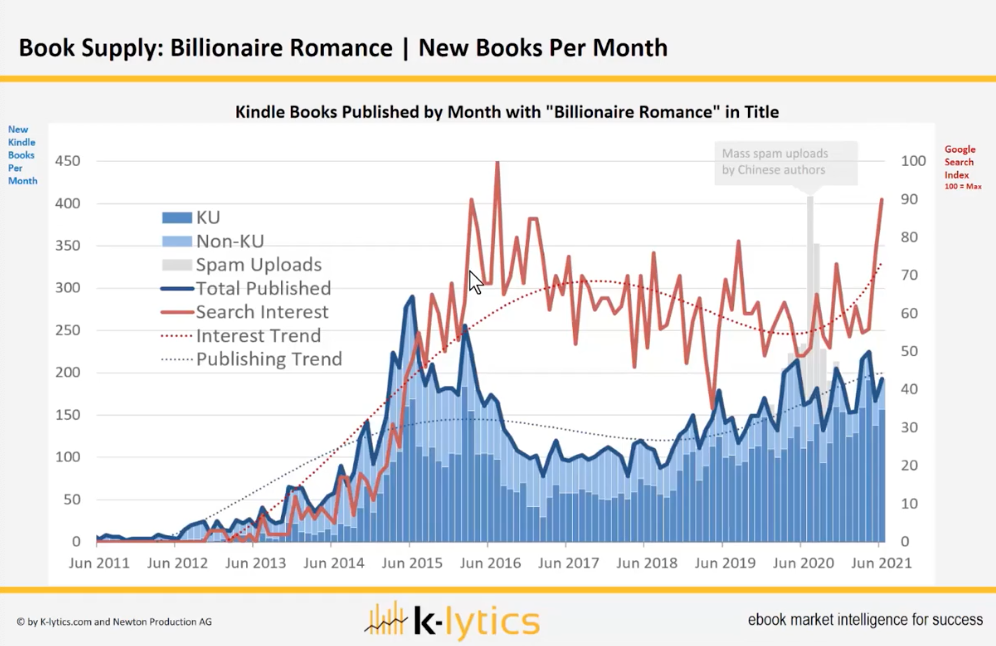
Billionaire romance is now one of the largest and most sustained sub-markets and has a variety of offshoots, from steamy to wholesome. Newton thinks the emergence of the category isn’t such a surprise when you think about it: “The billionaire romance genre simply fits perfectly into a particular Cinderella type of Hollywood mold—the romance between the rich guy and the ordinary girl. The trope’s roots go back to the silent era and can be traced further down to 16th-century ballads (‘The King and the Beggar Maid’). For romance authors today, it is a vast market.” Like vampire romance, he says, this category will never die. In terms of Google search volume (see below), interest has been peaking again, in fact, this summer.
But isn’t this a super competitive category? Newton notes that many books published in this category are now “dead”—published long ago and not being promoted. And if you look at the volume of titles now entering the market, it’s increasing, but search interest remains high in comparison. In 2015–2016, there was a peak in titles (and hype), followed by a cooling off period. But interest in the category has continued, and there’s both stability and opportunity. Spam uploads by Chinese authors hit the category last year, which also indicates the opportunity available.
How are such books positioned or marketed? Because there is no billionaire romance category on Amazon Kindle (only for print books), these novels have to use another umbrella category. The contemporary romance category can make sense, but this is a very competitive and high-performing mainstream market, so authors may seek alternate categories to compete in, like action & adventure romance or new adult & college romance. The latter is currently the most used category for the top 100 billionaire romance category. There is also increasing interest and sales in mafia billionaire romance, which often uses the crime category in women’s fiction. The majority (64 percent of top 300 titles) of billionaire romance covers feature the male protagonist. When covers feature something else, symbols of wealth outperform.
Mystery, thrillers, and suspense (MTS)
Newton reports that throughout the pandemic, this popular category has held on to its second best-selling sales position (after romance) on the Kindle platform. It has even trended up slightly. The key categories of suspense, thriller, and mystery are stable; however, crime fiction has seen a downturn in average sales rank lately, with the exception of crime fiction noir (up by 50 percent over the last year). The amount of new titles entering the MTS category has grown by 20 percent in the last 12 months.
A few high-level takeaways from his report, released in August 2021:
- Within MTS, paranormal stories featuring werewolves and shifters have seen the most sales rank improvement (by 68 percent). However, the driver of this has been paranormal romance. (A similar romance sales bump can be found in the vigilante justice fiction category.)
- There’s also an increasing influx of romance titles in the young adult MTS realm, with a considerable number of fae mystery-romance books, or titles that have paranormal and urban fantasy elements.
- Domestic thriller has been a strong category for a few years and continues to see gains.
- On a sales decline right now: historical mystery, police procedurals, medical thrillers, true crime.
- Horror has seen a very noticeable decline in sales over the last year. Newton says this is likely due to the Walking Dead trend; zombie-related horror has faded away. Overall, K-lytics trend data suggests that darker categories such as horror, post-apocalyptic, and dystopian have lost market share to more uplifting and escapist literature during the pandemic.
Bottom line: Newton warns that even if a category seems to be experiencing a sales bump or a sales decline, it’s necessary to check the titles making up the bestseller list to understand the driver of the trend. Category definitions are always broad, plus there can be category “invasion” or “pollution,” as mentioned with romance. By doing so, though, you can find unexpected top-performing titles, tropes, and trends that you may not have expected behind the category curtain. You can buy the billionaire romance report or the mystery/thriller/suspense report for in-depth analysis.

Jane Friedman has spent her entire career working in the publishing industry, with a focus on business reporting and author education. Established in 2015, her newsletter The Bottom Line provides nuanced market intelligence to thousands of authors and industry professionals; in 2023, she was named Publishing Commentator of the Year by Digital Book World.
Jane’s expertise regularly features in major media outlets such as The New York Times, The Atlantic, NPR, The Today Show, Wired, The Guardian, Fox News, and BBC. Her book, The Business of Being a Writer, Second Edition (The University of Chicago Press), is used as a classroom text by many writing and publishing degree programs. She reaches thousands through speaking engagements and workshops at diverse venues worldwide, including NYU’s Advanced Publishing Institute, Frankfurt Book Fair, and numerous MFA programs.