
Skillful use of A+ content can increase the number of readers who decide to buy
Have you ever noticed Amazon book product pages that showcase gorgeous interior photos of the book (especially for cookbooks), or that integrate highly designed blurb graphics? You were looking at A+ content, an Amazon product page feature once only available to certain publishers. Now it is open to anyone using Amazon KDP to publish. (Amazon KDP authors should go to their KDP Marketing page, then to the A+ Content Manager to access.)
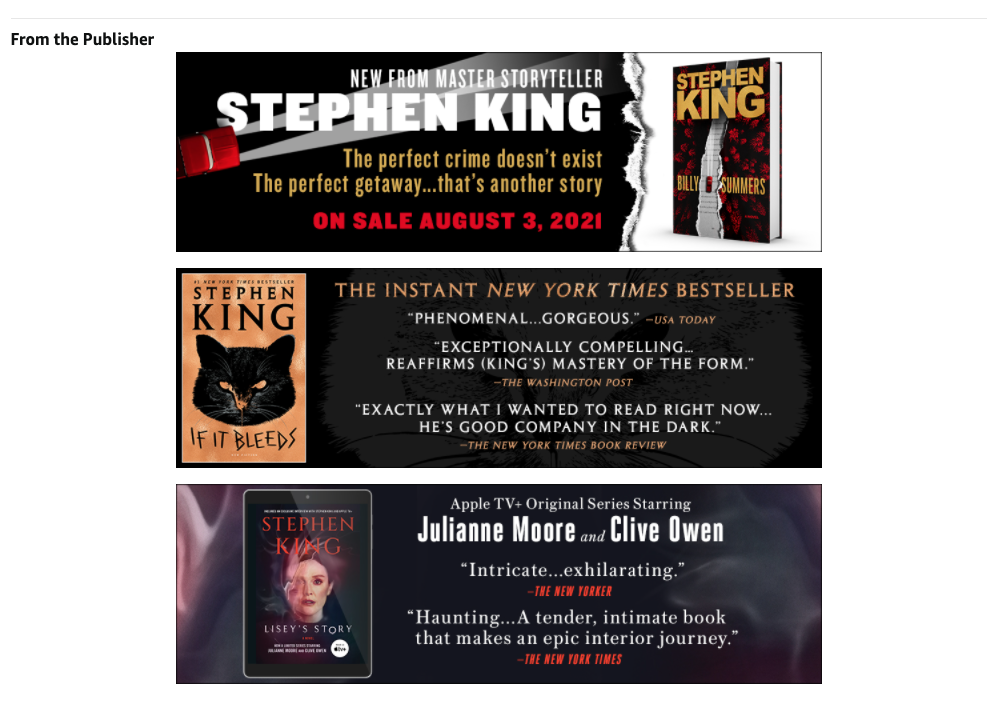
A+ content allows the addition of images, text, and comparison tables but prohibits a great deal of marketing language.
Some of the restrictions for KDP authors include:
- no pricing or promotional details or discounts (this means you can’t say something like “affordable,” “bonus,” or “free”) or anything of a time-sensitive nature
- no call-to-action language, such as “buy now” or “add to cart” or even “get yours now”
- no customer reviews
- no references to Kindle Unlimited
- no satisfaction or guarantee claims (e.g., “100% satisfaction guaranteed” or #1-rated)no discussion of competitors
- no links to other retailers or websites
- no contact information
KDP authors are limited to a maximum of four endorsement quotes as long as they are from well-known publications or public figures; they must be accompanied by an author, date, and publication credit if applicable. Only awards won in the last two years should be mentioned. We find that last one an odd restriction, but we suggest following the rules if you don’t want your A+ content to get rejected; you can review the full guidelines at the KDP site.
We reached out to a range of experts on Amazon optimization in the book publishing community for their advice on how authors can best use this section and the effect it might have.
First, A+ content can increase sales on Amazon and improve your search engine optimization. Amazon itself has said that A+ content increases sales an average of 5.6 percent, but of course there are many variables that can affect your success. Jess Johns, consumer insights manager at Ingram Content Group, tells us that studies across different product categories have shown anywhere from a 3 to 20 percent conversion rate improvement for products with A+ content. (Conversion rate refers to the percentage of people who buy after visiting the page.) Improved conversion rates on Amazon do lead to better discoverability so can have an indirect effect on Amazon search optimization. Also, even though A+ content itself is not currently indexed for Amazon search, it is indexed by Google, says Johns. So A+ content can support your overall search engine optimization efforts.
Penny Sansevieri at Author Marketing Experts believes A+ content is an important development for authors and tells us, “Not enough attention is paid to Amazon book page conversion, and A+ content will greatly enhance this book page conversion rate, if done correctly.”
Best practices for A+ content will depend on the book’s category or genre. But as a starting point, Sansevieri recommends discipline. “While it’s tempting to throw up a bunch of cool images, be sure they’re following some theme,” she says. “Use text and imagery to allow consumers to scan your content, but don’t clutter your image with too many words.”
Johns told us A+ content can make a difference more often for nonfiction and particularly for titles subject to comparison shopping, like self-help, how-to, hobbyist and crafting, cookbooks, children’s books, and gift books. She suggests using text modules for descriptive content and author details, rather than text embedded in an image, to support search engine optimization efforts. But not everyone needs to take a text-driven approach.
Romance authors are using A+ content for high-impact, showstopper image series. Deanna Roy, who writes rom-coms as JJ Knight, points us to two great examples: Jillian Dodd has created an entire story with her image modules for That Boy, and Penelope Bloom uses A+ content to give readers a close look at the hero of her book The Boss(hole). But some authors showcase a variant of the cover to capture a different market, says Roy. For example, an author might show the couple when only the hero is on the cover. The space then becomes an opportunity to present a secondary pitch for the book.
A+ content also offers a way to tie into social media marketing. Roy says that her A+ content matches her Facebook posts, reinforcing the reader’s decision to click through. (Here is an example, starting with her Facebook post, which links to the Amazon page.) “The ability to create this content and have images beyond the book cover helps solve one of the biggest disconnects between social media marketing and the Amazon sales page. We now have more control of the presentation of our page and can make key elements match. This image and marketing continuity of the A+ content has increased the sales conversion on my ads so much that my profit margins have soared and my ranking on Amazon has remained steady for weeks.”
Roy suggests that series authors might use A+ content to clarify large, complex storylines that can’t otherwise be explained, especially when several series are involved. Meanwhile, fantasy authors might create maps to fit the image modules; picture book authors might consider the best pages to display in the multi-image rows.
And what about nonfiction? Ian Lamont, publisher of In 30 Minutes guides, recently added A+ content for his In 30 Minutes cheat sheets for Microsoft Office. He uses it to highlight features (size, materials, keyboard shortcuts, etc.) and use cases (office workers, students, etc.), plus he takes the opportunity to cross-sell and upsell. (See image below or view more closely at the Amazon page.)
While some types of work have obvious ways to benefit from A+ content, if you’re still not sure how to make best use of it, Lamont suggests, “I would use an A+ module to highlight the author (background, passion, qualifications/awards), as Amazon’s default book product pages barely show any author info and force people to click off to the Author Central profile, which may or may not be maintained.” Sansevieri suggests using standout reviews, which seems like the default choice right now for new novels released by big publishers.
Still, be careful: A+ content could hurt you if used poorly. Roy says, “If you put up A+ content that does not confirm the reader’s decision to buy, or if it is poorly executed, then these modules could hurt you. On mobile, the A+ content comes first—above the sales copy. It has to be good.” Johns also emphasizes to us that A+ content does not replace a great book description since readers won’t see it unless they scroll past the description.
Bottom line: Johns says, “There’s increasingly little that we can control within Amazon, so it makes sense to influence what you can and give buyers as much information as possible.” For authors or publishers with a small number of titles, she recommends taking advantage of A+ content for all of your books. For extensive lists, it will be necessary to prioritize your efforts. She recommends focusing first on titles in highly competitive categories (especially where readers may be choosing between several similar works), titles you are advertising on Amazon or other channels (anywhere you are driving increased traffic to your Amazon page), and brands you are trying to establish or reinforce, like works in a series or author brands. Johns helpfully provided a list of A+ content examples if you’re looking for more inspiration.

Jane Friedman has spent her entire career working in the publishing industry, with a focus on business reporting and author education. Established in 2015, her newsletter The Bottom Line provides nuanced market intelligence to thousands of authors and industry professionals; in 2023, she was named Publishing Commentator of the Year by Digital Book World.
Jane’s expertise regularly features in major media outlets such as The New York Times, The Atlantic, NPR, The Today Show, Wired, The Guardian, Fox News, and BBC. Her book, The Business of Being a Writer, Second Edition (The University of Chicago Press), is used as a classroom text by many writing and publishing degree programs. She reaches thousands through speaking engagements and workshops at diverse venues worldwide, including NYU’s Advanced Publishing Institute, Frankfurt Book Fair, and numerous MFA programs.
