Leveraging a scale that’s difficult for other subscription services to match, Scribd keeps its terms with publishers flexible—and expands in ways that increase its competitive edge
In the US ebook subscription landscape, Scribd is the biggest (and only viable) competitor to Amazon’s Kindle Unlimited. Scribd has deals in place with major publishers and offers a deep backlist catalogue of Big Five publishing titles, while KU is mostly populated by mid-size and small publishers, Amazon Publishing titles, and indie authors.
Several years ago, Scribd’s unlimited consumption model showed signs of strain. Scribd announced cutbacks to its romance selection and limited subscribers to one audiobook per month. Then, in early 2016, it had to limit its subscribers to three ebooks per month. (See our coverage here.) However, in 2017, Scribd announced it had become profitable; in 2018, it returned to a (mostly) unlimited-consumption model for $8.99/month—one dollar cheaper than KU. And it has kept adding other types of content, such as magazines, as part of the subscription fee, to keep pace with Amazon.
Now, Scribd has announced a joint subscription offering with The New York Times. New subscribers to both services can get digital access to the NYT (site or app) and Scribd for $12.99/month. Typically, a NYT subscription is $14.99/month when not discounted. Scribd says it has more than 800,000 subscribers (half of them outside the US), while the Times has about 3 million digital-only subscribers.
Given the fairly restrictive paywall these days at The New York Times, where even casual readers are likely to reach their free article limit every month, this may be just the incentive needed to prompt readers to pay up. A Times marketing exec said Scribd is a good partner because, like the Times, it attracts educated readers willing to pay for content.
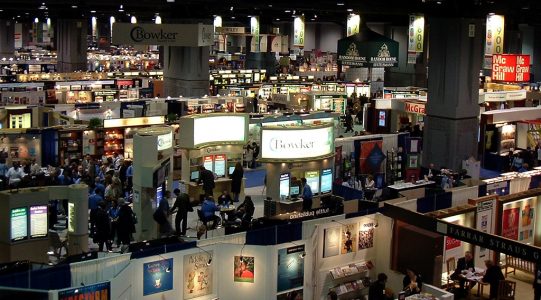
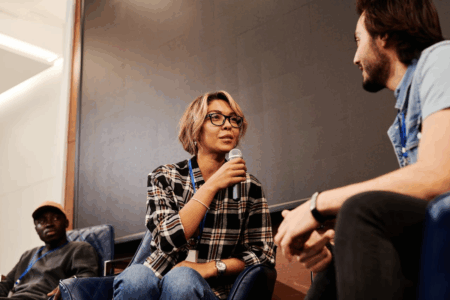
Earlier this month, Scribd CEO Trip Adler spoke to Porter in a Publishing Perspectives Talk at Frankfurt Book Fair on the International Stage. When pressed on how his offering has survived when so many reading subscription services—including Oyster—have failed, Adler stressed a broadly flexible model, describing a case-by-case approach to deals with publishers. His intent is to ensure each content provider in the system gets what it needs to be successful, rather than to impose strict system-wide controls that wouldn’t work for them all.
“What we offer publishers,” Adler said, “is a way of connecting the two sides of the ecosystem”: readers and publishers. He said Scribd offers “a frictionless reading experience for subscribers, and on the publishers’ side, we work really hard to take their books and make them available to this audience of readers. We offer publishers reach—we have more than 100 million [unique] visitors monthly. … In particular we’re really good at driving discovery to backlist books. And then we drive incremental revenue. We have people reading books at Scribd who wouldn’t be buying them elsewhere, and we help publishers get revenue from those readers.”
Adler conceded that Scribd has been a kind of guinea pig for the rest of the industry—like when it had to experiment and find practical solutions to high levels of romance reading—but also said that his company’s sheer scale insulates it from the kind of competitive vulnerabilities that a smaller, newer company might experience.
“In general, one of the hardest things for subscriptions is marketing … to get that initial adoption. You look at Netflix, which started with a physical CD service to market the streaming service, and Spotify had to spend a huge amount of money marketing a free music service just to get people into the top of the funnel.”
Outside the States, Adler said, Scribd is popular in Latin America, certain European markets, India, Indonesia, and Malaysia. “I think the reason we got so big in those markets,” he remarked, “is that we support the uploading of content in many languages.” By bolstering its support of local pricing, currencies, content, and search capabilities in overseas markets, Scribd will be pushing its international reach in coming months.
Bottom line: Adler said of Scribd, “We have all types of business models; we can get pretty creative.” That’s how he was able to strike a deal with The New York Times. Authors are encouraged by Scribd to make their books available; distributors that work with Scribd include Smashwords, INscribe Digital, BookBaby, and Draft2Digital. See Scribd’s info and FAQ for authors here.

Jane Friedman has spent her entire career working in the publishing industry, with a focus on business reporting and author education. Established in 2015, her newsletter The Bottom Line provides nuanced market intelligence to thousands of authors and industry professionals; in 2023, she was named Publishing Commentator of the Year by Digital Book World.
Jane’s expertise regularly features in major media outlets such as The New York Times, The Atlantic, NPR, The Today Show, Wired, The Guardian, Fox News, and BBC. Her book, The Business of Being a Writer, Second Edition (The University of Chicago Press), is used as a classroom text by many writing and publishing degree programs. She reaches thousands through speaking engagements and workshops at diverse venues worldwide, including NYU’s Advanced Publishing Institute, Frankfurt Book Fair, and numerous MFA programs.