
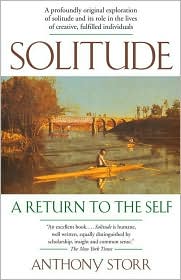
From Solitude by Anthony Storr:
Human beings need a sense of being part of a larger community than that constituted by the family. The modern assumption that intimate relationships are essential to personal fulfillment tends to make us neglect the significance of relationships which are not so intimate. …
The fact that a man is part of a hierarchy, and that he has a particular job to carry out, gives his life significance. It also provides a frame of reference through which he perceives his relation with others. In the course of daily life, we habitually encounter many people with whom we are not intimate, but who nevertheless contribute to our sense of self. …
Relationships of this kind play a more important role in the lives of most of us than is generally recognized. When people retire from work in offices or institutions, they miss the familiar figures who used to provide recognition and affirmation. It is generally accepted that most human beings want to be loved. The wish to be recognized and acknowledged is at least as important. …
People who have a special need to be recognized, perhaps because their parents accorded them little recognition in childhood, are attracted to office life for this reason. …
Intimate attachments are a hub around which a person’s life revolves, not necessarily the hub.

Jane Friedman has spent her entire career working in the publishing industry, with a focus on business reporting and author education. Established in 2015, her newsletter The Bottom Line provides nuanced market intelligence to thousands of authors and industry professionals; in 2023, she was named Publishing Commentator of the Year by Digital Book World.
Jane’s expertise regularly features in major media outlets such as The New York Times, The Atlantic, NPR, The Today Show, Wired, The Guardian, Fox News, and BBC. Her book, The Business of Being a Writer, Second Edition (The University of Chicago Press), is used as a classroom text by many writing and publishing degree programs. She reaches thousands through speaking engagements and workshops at diverse venues worldwide, including NYU’s Advanced Publishing Institute, Frankfurt Book Fair, and numerous MFA programs.

Fascinating and germane to a long chat today with a life-long missionary. Significance trumps “success”. The one reverberates outward the other too often disintegrates inward. He was beginning an auto-bio and wondered how that differs from a memoir. He doesn’t want a “successful” book, but wants it to linger on lives. Where do I go to catch for him important differences in memoirs and auto-biographies?
Gary, the key distinguishing feature between autobiography and memoir is that an autobio endeavors to tell of an ENTIRE life, birth to present. A memoir is limited to a particular period, or views one aspect of life through a specific prism. It’s not intended to relate the WHOLE of the life.
Some of this applies to the author’s/writer’s life – the need for ‘recognition and attention’ – but alternatively, the author/writer is often alone, encased.
It is facinating.
Very much agree! This book, in fact, delves into a deep examination of the creative life.
I wonder if Americans are particularly lax in honoring these secondary relationships with ritual &/or other ways to extend continuity? Years ago, I went all the way through graduate school with the same 14 people, studying, having lunch together, etc. It’s amazing to me how quickly we scattered, never to keep touch again in any way. Same thing with several workplaces. And yet these people still show up in my dreams from time to time. What a curious void between the two scenarios, a void into which plenty of retired people, for instance, fall. Defining these relationships *as* actual relationships, rather than as a framework (or “team,” yeah-rah) around which work is accomplished is surely the first step to solving this sad problem….?
Not sure if it’s specific to Americans or not, but interesting to consider. While I’ve had many actual/real relationships in work and school, the reason we don’t stay in touch has more to do with geography than anything …