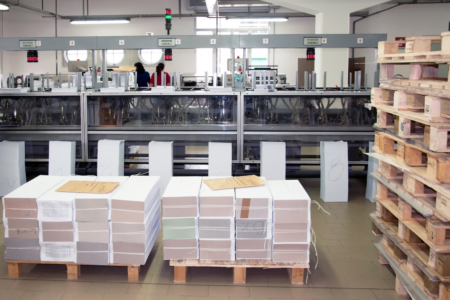
During summer and fall 2021, many industry alarms were sounded about supply-chain challenges and the possibility of a holiday sales crisis due to long printing turnaround times and shipping constraints. But whatever the problems might have been, book publishing still pulled through 2021 with print book sales up by nearly 9 percent, according to the latest figures from NPD BookScan.
But the supply-chain issues aren’t over yet—not by a longshot—not least because they pre-dated the pandemic. In a January 5 conversation hosted by the Book Industry Study Group, Bill Rojack of Midland Paper offered an update on primarily the domestic paper market for an audience of publishing professionals. While his comments were delivered with a can-do attitude and spirit of collaboration, he also did not sugarcoat the realities. Numerous times he repeated the phrase it’s scary in reference to paper market conditions.
There will not be enough paper capacity to meet demand for years. Rojack said, “I hate to be so dire about it, but it’s true.” He did qualify that statement by saying it’s important to look at specific market sectors—or types of paper—to understand where the pressures exist. As far as coated freesheet paper (often used for illustrated/color books), there simply aren’t enough paper mills and machines to meet demand in the foreseeable future, causing delays in pub dates. Your average novel is printed on uncoated freesheet, but that sector is seeing increased demand as the coated market downgrades to uncoated. And the uncoated paper market is losing manufacturing capacity with greater industry consolidation, with the possibility that paper mills will close even more paper machines.
While there’s more demand for book paper than ever, it remains a niche product. Book paper currently represents about 5 percent of the overall paper market, a percentage that has been increasing over time as demand dwindles in other sectors. However, Matt Baehr from the Book Manufacturers Institute commented that nobody is adding paper capacity because “no one is sitting there with a couple billion dollars, thinking, ‘My best return on investment is to open a book paper mill.’” Relative to some other papers, it’s expensive to make.
Another challenge is that private equity firms have bought up printing and paper manufacturing assets. Rojack said, “They don’t buy these assets to keep them the same. They’re trying to make more money on it and get rid of it. They may convert it or change the priority of the mill to get different grades. It’s scary. We don’t know if it’s going to happen. In the past five years, as private equity has gotten more involved in the paper business, it’s become a bit more unpredictable.” Unfortunately, paper profitability today often lies in converting mills over to packaging, such as Amazon boxes, or simply making more profitable grades of paper that aren’t used by book publishers.
Prices will go up, and publishers should seek partners, not discounts. Right now, pricing is 30 percent higher than it was two years ago. Rojack offered a clear and sobering wake-up call: “For all the publishers who are here [on this meeting], the paper mills right now are actually choosing their partners. And they’re not going to just choose them based on who they make the most money on. They’re looking at their futures,” Rojack said, “If you’re still talking price, you got a problem. You should be talking partners, not prices.” Does it mean publishers will have to increase book prices? That seems likely.
Bottom line: The consolidation and decline happening today in the paper market are dramatic and severe—and will be permanent, according to Rojack. So what’s the upside? Rojack said, “Our book business isn’t going anywhere. We’ve proven to the rest of the world that the printed product itself is superior. It’s here to stay.” But the publishing industry will have to consider how to better standardize and ultimately use fewer options for book paper. Rojack spoke of the opportunity to collaborate with paper manufacturers to come up with long-term, sustainable products and processes and to find solutions that work for everyone up and down the supply chain.

Jane Friedman has spent her entire career working in the publishing industry, with a focus on business reporting and author education. Established in 2015, her newsletter The Bottom Line provides nuanced market intelligence to thousands of authors and industry professionals; in 2023, she was named Publishing Commentator of the Year by Digital Book World.
Jane’s expertise regularly features in major media outlets such as The New York Times, The Atlantic, NPR, The Today Show, Wired, The Guardian, Fox News, and BBC. Her book, The Business of Being a Writer, Second Edition (The University of Chicago Press), is used as a classroom text by many writing and publishing degree programs. She reaches thousands through speaking engagements and workshops at diverse venues worldwide, including NYU’s Advanced Publishing Institute, Frankfurt Book Fair, and numerous MFA programs.