
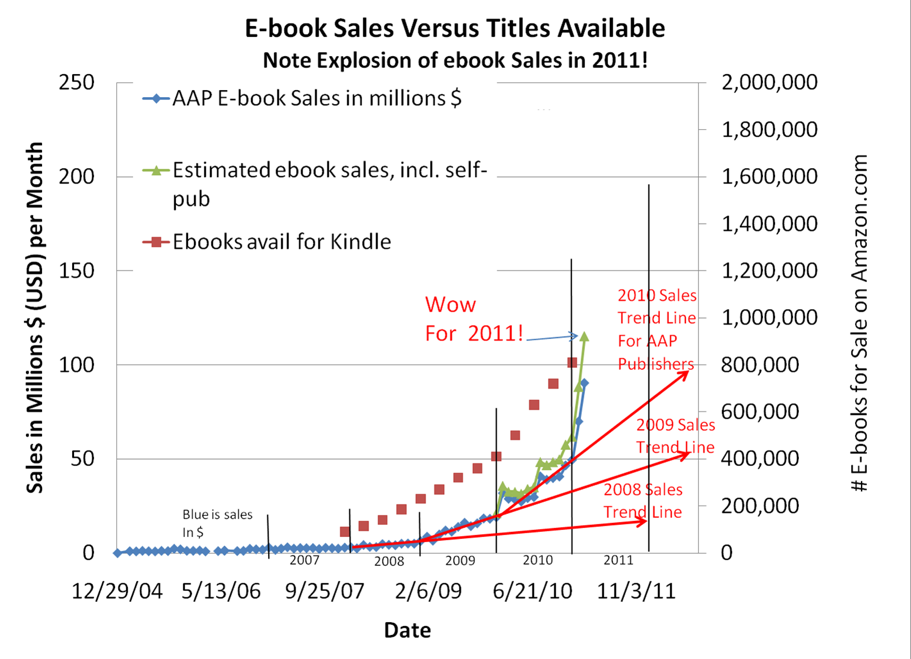
This weekend, I’ll be speaking at the Writer’s Digest Conference about e-publishing. I’m in the process of updating my slides and information about e-book sales—which can be a confusing and murky issue since the reporting of such sales is not as standardized as print book sales (yet).
Meaning: You can not only find various data sets, you can also find many interpretations. Above is a regularly updated graph from a blogger who has been following e-book sales reported by AAP (Association of American Publishers). It’s a good visual of how sales have picked up in recent years. (Click through for more of his graphs.)
When authors ask me about what’s next for the publishing industry, I try to point them to metrics to keep their eye on—since I find it hard to predict what will happen next. In that vein, here are two posts from this past week that nicely complement one another:
- E-Books Outsell Print for Majority of Titles on USA Today Bestseller List by Laura Hazard Owen at PaidContent. This article points to how, after the holidays, many traditionally published titles—the commercial bestsellers—are selling more units as e-book editions. The USA Today bestseller list is unique in that it combines print and e-book sales AND indicates which edition sold more copies. What authors should keep an eye on: Watch how many of the titles sell better in e-editions versus print. (It does switch back and forth!) Also look at which genres seem to repeatedly outsell in electronic editions. It’s impossible to draw any conclusions from only one week or one month, but if you watch the list for an entire year, you’ll stay grounded in industry discussions about just how much e-books are “taking over” or not. Publishers Lunch (sub required) recently noted that the inclusion of e-book sales (along with print sales) in USA Today’s list “barely” changed their reporting of overall 2011 bestsellers. But keep an eye on the composition of those sales.
- Top Self-Published Kindle E-Books of 2011: A Report by Piotr Kowalczyk at Teleread. This helpful parsing of Amazon data helps answer questions such as: Is the 99-cent price tag for e-books wearing out? Can we expect more success stories from independent e-book authors? Will self-published e-books continue to expand? Some of the most interesting data here is the number of self-published titles in the Kindle Top 100 bestsellers. In the best months, self-published titles claimed 20-27% of those spots. What authors should keep an eye on (especially those looking to self-publish): Pay attention to the Kindle Top 100 bestsellers and if the share of self-published titles increases. Also keep an eye on what’s being charged for these titles—because the more that indie authors can charge (and the longer bestseller status can be maintained), the more viable the indie route.
- Finally, keep track of the appearance of self-published e-book authors on traditional bestseller lists. For instance, in USA Today’s 2011 bestseller list, two out of the 100 bestselling titles were self-published e-books. For the New York Times bestseller list, during the whole of 2011, eleven self-published e-book authors made it to the list. As Publishers Lunch noted (sub required), that’s not very many authors considering how widely the self-pub millionaire trend has been trumpeted. Let’s see if the number grows in 2012.
Helpful links
As a side note, while writing this post, it felt antiquated how bestseller lists still segment out sales by edition (hardcover, paperback, mass market, electronic). If these lists are printed to serve and inform readers—and perhaps that’s a huge assumption?—how much does this distinction matter, except to those inside the industry? How much do these distinctions serve to keep the old paradigms in place? (E.g., “hardcovers” are more important or meaningful than “paperbacks”?)

Jane Friedman has spent her entire career working in the publishing industry, with a focus on business reporting and author education. Established in 2015, her newsletter The Bottom Line provides nuanced market intelligence to thousands of authors and industry professionals; in 2023, she was named Publishing Commentator of the Year by Digital Book World.
Jane’s expertise regularly features in major media outlets such as The New York Times, The Atlantic, NPR, The Today Show, Wired, The Guardian, Fox News, and BBC. Her book, The Business of Being a Writer, Second Edition (The University of Chicago Press), is used as a classroom text by many writing and publishing degree programs. She reaches thousands through speaking engagements and workshops at diverse venues worldwide, including NYU’s Advanced Publishing Institute, Frankfurt Book Fair, and numerous MFA programs.


11 in 100 is rather good when you consider how hard it is for a self pub author to get to the masses. And yes, i bet this number grows in 2012. If it could get to 20 then this would be huge for the self pub market, e-readers and e-books, and the book industry in general
Nice article and good luck with the conference
Matt (Turndog Millionaire)
To be sure, it was 2 bestsellers out of 100 (overall for the year, according to USA Today). If you look at how many self-pub e-book titles hit the New York Times list, it’s 11 over the course of the entire year (out of a much larger pool of titles).
Either way, though, I agree with you—it’s not something that has happened before at this scale.
This is encouraging news. I like to see authors have more control over their own created content.
Thanks for reading & commenting!
I’m just not sure bestseller lists are that applicable any more. Sales figures are much more viable; and in terms of dollars, not copies sold. I think it’s misleading to say the sale of a .99 eBook is the same as the sale of a $4.99 eBook. Especially for an indie author. We’re talking almost a ten times different in royalty rate. Publishing has always shied away from talking about money (pretty much everyone does) but I think we’re going to have to in order to understand the reality. I’ll be doing a post after Digital Book World where I’m going to get into the real numbers I had for 2011. The key for me is not bestseller lists, but broad base and long tail.
Well, the big question is, applicable to … what? If we’re tracking adoption of e-books, I think it’s a nice starting point. If we’re tracking the ability of self-published authors to be successful without a major publisher, no.
That’s one reason I mention keeping an eye on the Kindle bestseller list, and the price point of titles there. Piotr does a nice job analyzing the price point trend, which, as you point out, is important to indie author careers.
I agree about the configuration of bestseller lists being irrelevant at this point. I’m reading Jennifer Egan right now: on my Kindle, my laptop, my iPhone, and my husband’s iPad when I was in a pinch. Where do you credit that sale? Publishers are living in 1986, while the world of readers has moved ON. A book simply IS.
And I think 11 out of 100 is astonishing considering the momentum that those self-published authors create without the aid of the massive infrastructure of the big publishers. So cool!
Yes! … If you’d like to know, though: when reading Egan in an electronic edition across all those devices, the industry would count that as 1 e-book sale.
love your teaching style; wish I could attend the conference this year, but not to be. Appreciate the overall industry view and updates–have a great conference!
Thanks, Les!
Major point! Thanks for sharing.
It’s the Wild West. I’m hoping writers and publishers alike have learned something from the music industry. We saw this 10 years ago: everyone, creators and “publishers” alike, lost in the wilderness. I would argue the music industry never figured it out. The creators started touring more and took over distribution, and the superstars stayed within the confines of the publishers and the fall out is still, well, falling out.
Yes, between 1999-2009, I believe the recording industry lost about 50% of its revenues (approx $14 billion to $7 billion).
Great data and links Jane. Thanks!
I have both commercially published and self-published books, and I’ve been playing with various price points for my self-published E-books. I’ve noticed that the $.99 price point certainly moves more books, but that also makes it quite tough to make any decent money. I don’t know how valid this is, but I’ve begun to think of that price point as essentially running an advertisement. If you think of it that way, I’m actually getting paid a small amount of money to promote my work. The key then is to write up my $.99 E-books so that I can call attention to my other books where I can actually make a profit while still providing valuable information. In the midst of my $.99 promotion, I’ve also noticed that the majority of sales, if not all, have come from Kindle owners. I’ll have to keep an eye on this, but as a Nook owner, I’ve begun to wonder whether a KDP Select exclusive promotion would be worth it, especially for the five days I can offer the E-book as a free download and get some serious attention for it. I’m still thinking about that because I think the Nook is a really great E-reader.
I’ve heard anecdotes of authors who have been successful focusing on Nook sales rather than Kindle sales, but like you, when I hear requests for content (e.g., my own e-book or blog), it’s always for Kindle, not the Nook.
You must have brought me good luck Jane. 2 Nooks sales just came through. Maybe some Nook fans wanted to help support Nook books?
It is interesting to think about specifically targeting Nook owners. That could be interesting, since I think a lot of Nook owners made a pretty conscious choice of the Nook over the Kindle, which is often more of an automatic choice. Hmmm. I’m not sure if there’s anything to that.
Sales of my novel GHOSTS ON THE RED LINE for Kindle and Nook picked up substantially when I cut the e-book price to $2.99. By comparison, including Amazon’s current discount, the paperback version is currently priced at just over $11. Before Christmas when people were buying the paperback as Xmas gifts, there were more paperbacks sold than e-book copies. Now e-book copies are the top sellers.
GHOSTS ON THE RED LINE is self-published so the major challenge for both formats is getting the word out. Posters advertising the book were placed in Red Line trains during November-December. Now I’m relying more on Facebook and other social media. Also according to reviews on Amazon & BN.com and messages that I’ve received, readers like the book and are letting others know about it.
You might also see if GoodReads is a fit for marketing and promoting your book. (Sometimes a conversation is happening there that you don’t even know about!)
This is very interesting to someone who has not looked at the markets much since I graduated college 21 years ago. It does appear that self-pub may be (or become) an alternative, which is amazing. And I agree with your comments on hardcovers vs. paperbacks, etc.; however, from a business standpoint I can see why the publishers (and author, I would think?) would want to get as much return as possible before releasing subsequent versions – like first run movies, ‘bargain’ runs, Blu-Rays, DVDs and then television releases, I suppose.
You raise an issue that is vexing to consumers: release windows to help preserve industry profits. Some studies have shown that sales can be lost if you deny the consumer the format they prefer (contributes to piracy or lost attention).